

This Book is For:
*People who aren't willing to settle for a stable job and a relatively steady paycheck - who want to test their will in the open waters of the capitalist economy in the hopes of getting in, getting rich, and getting out before it's too late.
*Business owners who want to maximize revenue and profitability, and who aren't shy about doing whatever it takes to get their share of the proverbial pie.
*Anyone who thinks that money can solve everything, but who might be open to having their minds changed concerning how much is enough, when to stop, and what to do after their big exit.
Summary:
“I’m fully aware that this isn’t a book about becoming a worthwhile human being. As I keep attempting to drum into you, riches aren’t particularly worthwhile in themselves in any case. They don’t make anyone a better person, at least as far as I have seen.
But listening continuously, listening and learning, is one of the vital components for those of you who wish to be rich. What you choose to do with your loot is up to you. But listen and learn if you want to be rich!”
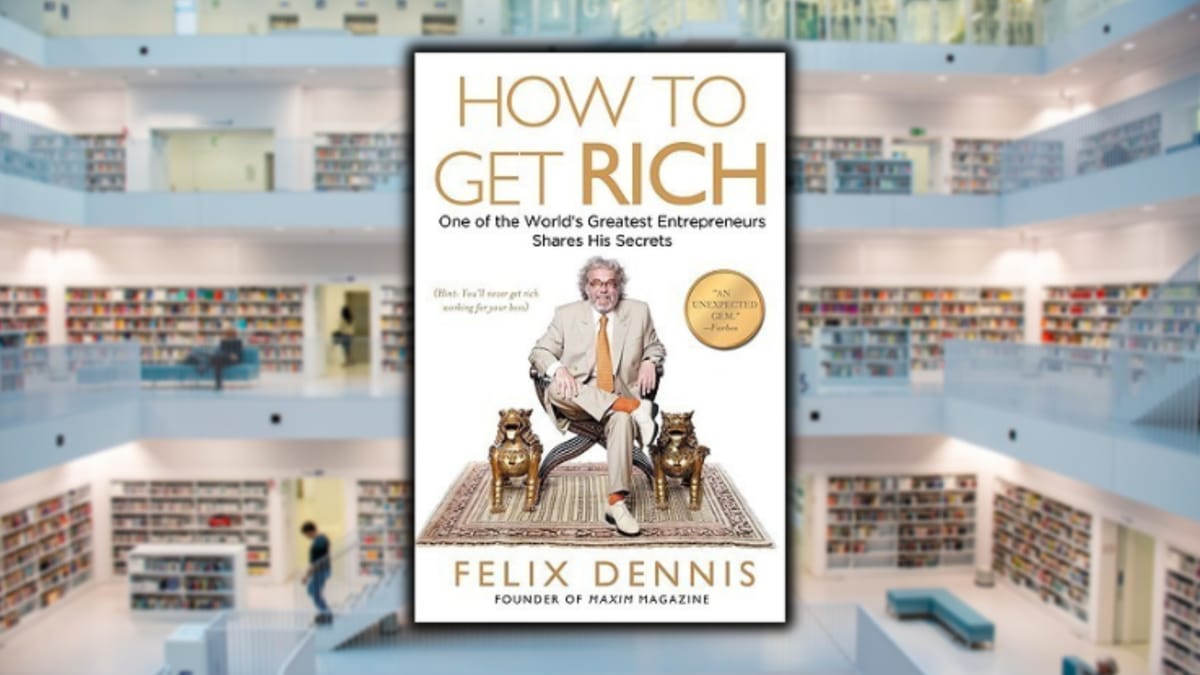
This is one of the rarest and most sincere "how to make a lot of money in business" books that you'll ever read, and interestingly enough, Felix Dennis spends a solid 15% of it trying to convince you not to bother.
During his life, Dennis built a UK magazine publishing empire and amassed a personal fortune of well over $600,000,000. But the book's somewhat tragic tone comes from the fact that he was racked with regret at the end of his life, writing this book from inside his cold, solitary castle, seemingly shaking you by the shoulders and saying, "Don't do it! Don't do it, or you'll end up like me!"
And yet…he almost can’t help himself. After his initial protests, he concedes: “Really? You still want to do this? Alright then - here’s how to get rich.” What follows is some of the best business advice out there, delivered in Dennis’s uniquely poetic, brutally honest style - advice that will make you rich, if you have the desire and the fortitude to follow it. Castle included.
Dennis went from college dropout to centimillionaire publishing magnate, all the while harboring an immense talent and love for poetry and literature. In fact, he even became a poet himself, performing some of it for audiences while he was alive. Looking back at his pursuit of riches from the end, however, he tells us that he (and probably you) would have been much happier had he known when to stop.
How to Get Rich is packed full of incredibly profound lessons on restraint, human desire, meaning and fulfillment, boldness, character and more, while also delivering astoundingly helpful lessons on things like negotiation, ownership and equity, and how to get what you want in life and business.
Unfortunately for Felix Dennis, he learned the lessons about restraint and desire too late, and it cost him everything. Fortunately for you, here in this book he lays bare everything he knows about the realities of starting and growing a business, what sorts of challenges you're likely to face on the way to becoming rich, and how to know who to trust as you keep breaking into new tax brackets. In other words, how to make your millions while dodging the bullets that took him out.
Just make sure you know what you're getting into. That's all that I and Felix Dennis ask of you! Getting rich can be a hell of a rush, and it has a way of taking over your whole life if you let it.
Same with running a business. It can be extremely difficult, it's uncertain, it can take a long time, it can ruin your relationships and alienate you from the people you work with, and once you get to a certain level of personal wealth, it can be very difficult to tell who your real friends are.
Even $600M couldn't save Felix from devastating dissatisfaction and regret, and it's unlikely that $700M would have done it either.
I believe (perhaps not too controversially) that being rich is better than being poor. Entrepreneurship, as a vehicle for personal transformation and expansion of the self is unmatched, in my opinion, second only to physical training, reading great books, and losing yourself in the service of others.
So I'm not going to tell you not to get rich, either. But you have to ask yourself, earnestly and sincerely: "Do I really want to do this?"
The answer is non-obvious and shouldn’t be rushed. Read this book first, and ask yourself whether you’re willing to pay the price that Dennis paid. Regardless of your answer, I think you'll agree that this is a very special book, and one that you won't soon forget.

Key Ideas:
#1: Don't Try to Get Rich - Plant Trees Instead
“If I had my time again, knowing what I know today, I would dedicate myself to making just enough to live comfortably (say $60 or $80 million), as quickly as I could - hopefully by the time I was thirty-five years old. I would then cash out immediately and retire to write poetry and plant trees.”
Most "how to get super rich" books spend the first 20-50 pages trying to hype you up, motivating you, and getting you to envision all the wonderful things that are going to happen once you finish reading the book and start to apply the author's teachings in your life.
Felix Dennis, who was way richer than most of the authors of books like that, was having none of it. He spends the majority of the book trying to convince you not to get rich at all.
The reason for this is simple, and more than a little tragic. Dennis spent virtually his entire life amassing more wealth than he could count (literally), and yet he wound up writing those words in what was essentially a cold, empty castle, absent the happy sounds of friends' voices, the play of children, and the warmth of a devoted family that could love him back.
From death's door, after it was too late to change course (Dennis died of throat cancer back in 2014), he was driven by two seemingly conflicting motivations: help sufficiently motivated people accumulate enough "F-U Money" to be able to do anything they wanted, and convince those same people that stacking up piles of cold, hard cash wouldn't save them from dying alone in a cold, empty castle.
Personally, I derived a double benefit from Dennis's book, and I'm sure he's helped many other people like me avoid making a deadly mistake. When I first read How to Get Rich, I was making more money than I ever had before, but I rarely saw my friends, virtually never went out (except to go to the grocery store and the gym), and was headed for an empty castle myself. Luckily, I was able to notice this in real time and course-correct before it was too late.
We can get so caught up in the singular pursuit of wealth (or anything, really) to the point where it takes over our whole life, and we forget that it's not the only thing that's important. That's what was happening to me, and what is happening to great multitudes of people today who are stuck endlessly competing, running faster and faster in a race to nowhere.
Nobody wins a race they don't want to be in, and Felix Dennis has the right idea here in that we should never lose sight of our ultimate aim. It's far too easy to overshoot it, only to wake up years later in a life we never wanted, one that's too difficult or too late to get out of. Sahil Bloom, in his excellent book, The 5 Types of Wealth, calls this winning the battle but losing the war.
What's helpful here is to get very clear on your "enough" number, and writing it down in a place where you can see it often. It's a number that, after you reach it, you decide that you can rest easy, knowing that you have enough. For myself, that number is about $50,000 per month in income, and I'm sure that if Dennis had ever sat down and decided on his "number," it wouldn't have been $600,000,000!
But perhaps even knowing your "enough" number isn't quite enough. Dennis hit on this idea, as well as a possible reason for this, in the following quote:
“It’s no excuse, but making money is a drug. Not the money itself. The making of the money. This sounds like so much hoopla, but it’s true, all the same.
Nobody believed that exercise could prove addictive until science stepped in and discovered ‘endorphins’ or whatever the damn things are called. And making money, I assure you, is a hell of a lot more of a rush than jogging.”
#2: Ignore the Odds
“If the odds of getting rich put you off, then you deserve to stay poor. Or, to put it more kindly, whether you deserve it or not, you will stay poor.”
Most people aren't rich, will never become rich, don't even deserve to become rich. Most people just don't make it. That's the reality. But it doesn't have to be your reality. You can be, quite literally, exceptional.
Just "believing" that you'll eventually become rich ain't it, either. But it does involve a seismic shift in your belief system, a semi-delusional, near certainty that you can defy the odds. That you can become rich. Alex Becker, in another book I recommend highly, The 10 Pillars of Wealth, says this:
“By wanting to become wealthy, you are also saying that you want to accept the challenge to be better at making money than 99 percent of the people on this planet.
Just by attempting this, you are going to have to accept the fact that you must not just be good, you must be incredible. If you think differently, then you are done before you even get started."
You have to have this level of (internal) arrogance and self-belief if you want to have any realistic chance of beating the odds and getting rich.
You have to have the belief system that says, "No, I'm not like most people. I'm better at making money than the vast majority of people, or at least I have the potential to become better at making money than the vast majority of people, and no matter what, I am going to make it."
You can't say, "Oh, well, I'm not sure if that's really for me. I mean, I'll give it a shot, do my best and whatnot, but I'm not convinced it'll work out." If you say things like that - if you even think things like that, you'll likely remain poor.
Now, that does not mean that you have to go around shoving this attitude in other people's faces. That's not what I'm saying at all. I'm talking about your internal beliefs about what's possible for you, and what you're capable of attempting. It has nothing to do with other people. It's an inside game.
#3: Grow a Carapace
“There were a hundred obstacles and hurdles in those days, visible and invisible, to keep women in their place - which was firmly believed to be on a pedestal before marriage and in the kitchen and nursery directly afterward.
Fortunately for all of us, society has wised up somewhat; but the change came too late for my mother. So she didn’t become rich. She had a decent career, that’s all. She earned enough to support my brother and me and to provide us with more than just the necessities of life. And she married again and became a pillar of the community.
But I know that she could have done it, had she been prepared for the unpleasantness, the sheer nastiness that would have been unleashed upon her if she had chosen to say: ‘To hell with them. Let’s go!’”
The people who came after Felix Dennis's mother still exist. The names and faces change, but they're still out there. I call them the 99 percenters. They're the people who've given up on their own dreams, so they take it upon themselves to try and destroy yours. No matter what you have to do, never let this happen.
You have to protect your mind from the 99 percenters at all costs. They're the people who don't see it happening for them - who don't believe that they can get rich - so they try to get the image of future riches out of your head too. Get them the fuck out of your mind, and out of your life. They're as nothing to you.
Run an ad campaign inside your mind, where you bombard your conscious and subconscious minds with positive thoughts, positive imagery, supportive words, shining examples, and inspiring role models. All day every day. Turn up the megaphone inside your mind and drown out all the negativity from the 99 percenters who try and get in your way.
Christiano Ronaldo is phenomenal at this, by the way. If you've ever seen him talking to himself, motivating himself, shielding himself from both the internal and external negativity - it's something to behold! He's completely on his own side, and his mental fortress is locked the fuck down. That's the level of self-belief we should all aspire to!
Mind you, even he still has coaches and mentors. So do I, and so does basically every mega-successful person you've ever heard of. We all have trainers and coaches and experts we bring in to help us get to the next level. We listen to those people. But never to the 99 percenters.
The news is full of 99 percenters, by the way. Which is why I never watch it. It's a constant stream of negativity, mental pollution, and awfulness that has never once positively contributed to my getting rich. So I literally have no time for it. None.
What you're really doing here is reprogramming your own mind for wealth and success. It's important work - this growth and development into new mental territory - and it's all too easy for the 99 percenters to fuck it up. I don't usually swear this much in any one piece of writing, but I do feel very strongly about this.
Fuck the 99 percenters. Fuck the negativity, the outrage, the fear-mongering, and the senseless drama. Leave all that stuff for the brokies. You're on your way to becoming rich. You can't water and poison your own mind at the same time and expect to get rich, and you can't leave it open to the deleterious influences of the 99 percenters. Felix Dennis understood this acutely when he said:
“To sum up then, if you wish to be rich, you must grow a carapace. A mental armor. Not so thick as to blind you to well-constructed criticism and advice, especially from those you trust. Nor so thick as to cut you off from friends and family. But thick enough to shrug off the inevitable sniggering and malicious mockery that will follow your inevitable failures, not to mention the poorly hidden envy that will accompany your eventual success.”
#4: If...
“If you are unwilling to fail, sometimes publicly, and even catastrophically, you stand very little chance of ever getting rich.”
“If you care what the neighbors think, you will never get rich.”
“If you cannot bear the thought of causing worry to your family, spouse, or lover while you plow a lonely, dangerous road rather than taking the safe option of a regular job, you will never get rich.”
“If you have artistic inclinations and fear that the search for wealth will coarsen such talents or degrade them, you will never get rich. (Because your fear, in this instance, is well justified.)”
“If you are not prepared to work longer hours than almost anyone you know, despite the jibes of colleagues and friends, you are unlikely to get rich.”
“If you cannot convince yourself that you are ‘good enough’ to be rich, you will never get rich.”
“If you cannot treat your quest to get rich as a game, you will never be rich.”
#5: Few Are Prepared to Make the Necessary Sacrifices
“After all, if everyone was prepared to make the necessary sacrifices, who would be left to work for my own companies?”
Again, most people will never, ever become rich. But you can't even worry about them. Encourage them whenever possible, and be a positive example to others, but you can't feel guilty that you took positive action and they didn't.
The ways and means of success are readily available to most people (and becoming available to more and more people every single day), but you can't be responsible for anyone else's success except your own.
Many of the people that Dennis is talking about could have become rich, but they chose not to be. Maybe it wasn't necessarily a conscious choice, but it was a choice all the same. They could have become rich, but they didn't make the necessary sacrifices. They were too fearful, too lazy, too uncertain to take a positive step forward in belief.
No matter. That has nothing to do with you, nothing to do with what you're capable of. Sure, go ahead and help them out when you get rich, but don't waste your brainpower or your willpower trying to save people who don't really want to be saved.
#6: Never, Ever, EVER Give In...Easily
“‘Never give in’ is a useful catchphrase. But don’t take it too literally. We must all surrender at some time, to love, or desire, or death. You will be forced into the last of these, and a fool if you never surrender to the first. But never give in easily.
If you can, attempt one step farther along the road than appears sensible before giving in. ‘Persistence’ is a vital attribute for those who wish to become rich, or who wish to achieve anything worthwhile for that matter. As is the ability to acknowledge that one has made a mistake and that a new plan of action must now be made.
Any such acknowledgement is not a weakness, it is a sign of clear thinking. In its way, it is a kind of persistence in itself. Try, try, try again, does not mean doing what has already failed, over and over again.
Quitting is not dishonorable. Quitting when you believe you can still succeed is. You must keep the faith. Belief in yourself and faith in your project can move mountains. But not if you insist on trying to scale the mountain by an impossible route which has already failed.”
There's a great quote often attributed to W.C. Fields, where he says, "If at first you don’t succeed, try, try again. Then quit. There’s no point in being a damn fool about it." That's pretty much the energy that Felix Dennis is bringing here.
Hard work, grit, and persistence are all wonderful traits, and they can serve you extremely well in life. But if something's obviously not working, don't be a damn fool about it! Have the self-awareness to recognize that what you're doing isn't working, and the courage - yes, the courage - to change course.
But Dennis brings up two very important points here, one of which is that, when faced with difficulty, you should be prepared to take at least a few steps more than what seems sensible, past the point where the 99 percenter would be okay with quitting. Go ten steps past that. That's where winning is.
At the same time, however, after taking those ten extra steps, if you see nothing happening - nothing at all - then you may want to re-evaluate your approach, take another look at your strategy, get some help, etc.
As you can see, there's a level of nuance here, and on a case-by-case basis, it can be very difficult to tell when you "should" give up. But if you're paying attention, you'll know. And, on the other hand, if you can see a path forward - if you can see the possibility of success - you must keep the faith. You must push on. You must.
#7: Get Some Eggs, Then Make More Baskets
“I am one of the richest self-made men in Britain for two reasons. I own my company outright, and I began to make more baskets the minute the first had a few eggs in it.”
In Key Idea #10 we'll explore equity and ownership, but here we're discussing diversification and multiple streams of income.
There's more danger and nuance here as well, but Dennis does make an important point about not relying on just one single stream of income, and not having any one single point of failure in your business ecosystem.
There's a difference though between making more baskets (diversifying your income streams) and chasing a bunch of shiny objects. As the Russian proverb has it, he who chases two rabbits catches none, and so help me, if I have to hear about one more 18-year-old "CEO" running 5 different businesses, I'm gonna lose what's left of my mind.
Starting 5 different businesses and earning $1,000 per month from each one isn't hard. But for the same amount of effort, you could focus on growing one business to $10,000 per month or more. That makes a whole lot more sense. Yes, there's something to be said for spreading your enterprise risk over several different revenue streams, but trying to run 5 unrelated businesses is not it.
Myself, I run precisely one business, within which I cultivate several different revenue streams. They may look wildly different (YouTube, book marketing, my newsletter, Patreon, writing on Medium, affiliate marketing, etc.), but they each support and enhance each other.
For example, you may know that I take detailed notes on every book that I read. Those notes form the basis for my newsletter, and they're also made available on my Patreon. I use my newsletter as material for my articles on Medium, for my YouTube videos, my social media posts, etc. I use my newsletter and massive social media audience to help authors sell more copies of their books, which they pay me for. And of course I share affiliate links across all those same platforms.
This is one single business that I run, based on books, and all my revenue sources are upstream of my book notes essentially. A bunch of eggs, in a variety of closely-related baskets, in other words.
It's all about energy and focus management. A good way to picture it is as though you're trying to harness the sun's energy. When the sun is shining on a regular, sunny day, the sun's rays are spread over the entire earth. And of course it feels...nice! Relatively warm, just another nice sunny day. But, when you filter the sunlight through a magnifying glass, you can start a blazing fire. It's the same idea in business.
Having your focus and energy spread out across several different business operations is like walking around on a warm, summer's day. It's not bad! You're not making great progress in scaling your business or your income, but you can live like that for a while. But, when you filter your own personal resources through the magnifying glass of one singular business objective, the sun's rays become literally incendiary.
#8: Why Intelligent People Fail in Life
“Albert is more intelligent than I am. He had a grand education and read all the right books at university. He is not a self-taught scholar, as I am. But there is a downside to all this intelligence and imagination. He thinks a little too much before he acts. He weighs the options too carefully. He is capable of imagining defeat.”
In the book, Felix Dennis tells the story of a friend of his, Albert, and about the reasons why Albert never became as rich as Dennis did. It wasn't because Dennis was smarter, or had any other unfair advantages from birth. It was simply because Albert was capable of imagining defeat.
There's another fantastic book, Zorba the Greek (one of my favorites of all time, actually), where Zorba is telling the narrator not to be so much of a pen pusher. The latter's life was all paper and ink and books, to which he retreated instead of rushing out into the great wide world and living his actual life! The narrator's predicament is something I and many other people know a little something about. Maybe you do too. It's possible that you think too much and live too little.
You don't need to have your entire business plan laid out before you take the first step forward in belief. As they say, no plan survives first contact with the enemy, so it's likely that your strategy and/or tactics will have to change anyway. None of that, however, is to say that you need to wait to take the first step. Start walking, and the way will appear.
Additionally, it's a waste of time to wish for other people's gifts or advantages. Cultivate your own. Develop your own strengths; create your own unfair advantages, and deploy them relentlessly.
It all comes down to taking massive action. Take the first step. Advance confidently in the direction of your greatest ambitions. Because Zorba was right: "Action! Action! No other salvation exists."
#9: The Absurdity of the Chase
“If you chase money desperately in the earnest belief that you can never be happy without it and seriously think that the chase is a meaningful occupation, I doubt very much you will succeed. You have to be fiercely determined, true. But an appreciation of the absurdity of the chase helps enormously.”
There's a fantastic business book that I recommend all the time called The Millionaire Fastlane, by M.J. DeMarco. In the book (which I read on my phone, overnight, sitting in my car, working a minimum-wage security job while launching my business at the same time), he says two things that are perfectly relevant here.
One is that wheelchairs don't fit inside the trunks of Lamborghinis. Meaning, the earlier you can get rich, the better, and don't listen to anyone who tries to tell you that trading your health and 40 years of your life in exchange for slightly-above-average wealth is a good deal. It's a total scam, and a devastating lie that society pulls over the 99 percenters.
But the second thing that he says is that he was happy before he bought his Lamborghini. At the time of writing, I just sold my Porsche and my next car will be a Lamborghini Gallardo that I'm planning on buying later this year. But I'm happy now. I'll be happy when I buy my Lamborghini, I'll be happy the day after, and I was happy way back when I was reading The Millionaire Fastlane in the front seat of my Mitsubishi Eclipse!
What I'm getting at is that a certain level of detachment and self-awareness when it comes to wealth and happiness goes a long way. If you can maintain perspective and a rare sort of clear-headedness when it comes to wealth-accumulation, you'll be so far ahead (above, really), all those who are caught in the mousetrap below, running faster and faster amid the fray. This quote from G.K. Chesterton sums it up quite nicely:
“To be clever enough to get all that money, one must be stupid enough to want it.”
#10: Extreme Ownership
“To become rich, every single percentage point of anything you own is crucial. It is worth fighting for, tooth and claw. It is worth suing for. It is worth shouting and banging on the table for. It is worth begging for and groveling for. It is worth lying and cheating for. In extremis, it is even worth negotiating for.
Never, never, never, never hand over a single share of anything you have acquired or created if you can help it. Nothing. Not one share. To no one. No matter what the reason - unless you genuinely have to.”
Here Dennis is speaking about equity: owning as much as possible of the value you create, whether in the form of royalties, revenue split, company shares, etc. He takes a rather extreme view (and it helped him generate extreme wealth), but he's also not wrong. Don't give up any equity that you don't have to.
When you're first starting a company, and you're making approximately $0 (or even operating at a loss), it can be easy, not to mention attractive, to give up a whole bunch of equity in exchange for assistance in the form of capital, etc.
If you're not 100% convinced that your new venture will be success, it's so tempting to give up as much equity as you have to in order to keep the lights on. After all, what's 50% of $0? 75% of $1,000/month? Why wouldn't you accept somewhat predatory terms, if you think that it's the only way your business will survive and succeed. But what if you do make it?
What if, after you make it through that first year or two (or ten), your business starts growing, and you start making money hand over fist? You're still locked in to those damn-near predatory investment terms, forced to hand over 50% of $100,000/month or more. Do you still think it's a good trade?
Felix Dennis's point is that you need to be extremely greedy when it comes to holding onto your equity, and you need to make sure that you own close to 100% of as many wealth-generating assets as you possibly can. If, that is, you want to become rich.
Of course, you don't have to go to such extreme lengths, and in the Opposing Views section below, I offer an alternative viewpoint to take into consideration. Briefly, to quote Zig Ziglar, you can get anything you want in life, just as long as you help enough other people get what they want.
That might mean giving up some equity. It might not. But Dennis is directionally correct when he emphasizes the importance of owning income-producing assets, and not giving away money that you don't have to, just because you're afraid that it won't be there later.
#11: Give the Glory, Get the Money
“If you own a company and that company’s purpose is to make you wealthy, you will be content, delighted even, for any amount of glory to go to anyone who works there, providing you get the money.”
Following up on the last Key Idea, you can also accomplish a tremendous amount in life if you don't care who gets the credit. That's what Felix Dennis is getting at in the quote above. Give them the newspaper headlines! Give them the industry awards and standing ovations that come with them. Providing you get the money!
If you give all the glory, you can get all the money, a point that Napoleon Bonaparte understood extremely well. He once remarked that "men will die for ribbons," and this is still true today. Toss people some trophy, medal, or public recognition of some sort, and they'll literally face cannon fire for you.
Maybe you don't want to be so Machiavellian about it, but it's still true! You can use this fact of human nature to get rich. Give the glory, get the money.
#12: The Eight Secrets to Getting Rich
1. Analyze your need. Desire is insufficient. Compulsion is mandatory.
2. Cut loose from negative influences. Never give in. Stay the course.
3. Ignore “great ideas.” Concentrate on great execution.
4. Focus. Keep your eye on the ball marked ‘The Money is Here.’
5. Hire talent smarter than you. Delegate. Share the annual pie.
6. Ownership is the real ‘secret.’ Hold on to every percentage point you can.
7. Sell before you need to, or when bored. Empty your mind when negotiating.
8. Fear nothing and no one. Get rich. Remember to give it all away.

Book Notes:
“Why would a rich person waste time writing a book to help other people get rich? Two reasons. Because I enjoy writing something I feel I know about. And because I believe that almost anyone of reasonable intelligence can become rich, given sufficient motivation and application.
It also helps that I am writing while sipping a very fine wine indeed (a Chateau d’Yquem 1986 if you really want to know), nibbling on fresh smoked conch tidbits, ensconced by a window with one of the most beautiful views on earth.”
“People who grow rich almost always improve their sex life. More people want to have sex with them. That’s just the way human beings work.”
“Knowledge learned the hard way combined with the avoidance of error, whenever and wherever possible, is the soundest basis for success in any endeavor.”
“Rich enough to live where you want, to go where you want, to do what you want, to meet who you want. Rich enough to buy the only two things apart from health and love worth fussing about in life. Time. And the option of not having to be in any particular place on any particular day doing any particular thing in order to pay the rent or mortgage. And rich enough to begin to worry about taxes.”
“It sounds crazy, but the richer you are the more financial advisors you employ, the less likelihood there is that you can ever discover what you are really worth. It’s a nice problem to have, but it’s still a problem.
This is why so many rich people distrust the ‘rich lists’ and league tables of wealth published every so often in newspapers and magazines. We know that if we cannot calculate our true net worth, and if our paid armies of accountants cannot agree upon a figure, then compilers of lists and financial journalists certainly cannot do so with any real accuracy.
In the words of the art collector and oil billionaire John Paul Getty: ‘If you can actually count your money, you are not really a rich man.’”
“Money, it turned out, was exactly like sex. You thought of nothing else if you didn’t have it, and thought of other things if you did.”
-James Baldwin
“Of course, all measurements are arbitrary. They are just an attempt by humans to make some kind of order out of a chaotic universe. In and of themselves, they are meaningless.”
“Now, enough waffling about definitions. Let’s get down to making some dough. Let’s get rich!”
“No task is a long one but the task on which one dare not start. It becomes a nightmare.”
-Charles Baudelaire
“Conventional wisdom is usually right. But when it is wrong, it can offer quite extraordinary opportunities for those too stubborn or inexperienced to pay attention to well-meaning naysayers.”
“The only way to deal with fear is to cozy up to it. To look it in the eye and pump its hand. To translate its negative energy into adrenaline. To harness it. To laugh with it, rather than at it.”
“A committee is a cul-de-sac down which ideas are lured and quietly estranged.”
-Sir Barnett Cocks
“A committee is a group of the unwilling, chosen from the unfit to do the unnecessary.”
-Anonymous
“Committees are discouraged on the battlefield. A commander may be proved wrong. He may be proved right. But prompt decisions and orders, right or wrong, are far healthier than endless debate and prevarication. This applies equally to a debate within one’s own mind.”
“The Germans have a superb word for the (secret) pleasure humans obtain from the misfortunes of others. It is schadenfreude - from schaden meaning ‘harm’ (from which we get the word ‘shadow’), and freude meaning ‘joy.’
Those of you who are definitely going to be rich will recognize it often enough in the faces and body language of idiots around you. It is the price you must learn to pay for any attempt to raise yourself in the world. And I suspect that was as true ten thousand years ago as it is today.”
“A horse can be tamed, bridled, saddled, harnessed, and (eventually) ridden. Harnessing the power of such a creature adds mightily to your own. Thus the nightmare of prospective failure provides you with the very opportunity you are seeking.
Not only does it restrain smarter people than yourself from becoming rich - and there can only be so many rich people in the world - it affords you the chance of increasing your confidence, both when you confront it and when you master it.
For make no mistake, if you will not confront and harness this all-too-human emotion in one way or another, then you are doomed to remain relatively poor. You either get over it, go around it, go at it, mount it, duck under it, or cozy up to it. But you cannot surrender to it. That way lies paralysis, prevarication, ignominy, and defeat.
After a lifetime of making money and observing better men and women than I fall by the wayside, I am convinced that fear of failing in the eyes of the world is the single biggest impediment to amassing wealth.
Trust me on this. If you shy away for any reason whatever, then the way is blocked. The gate is shut - and will remain shut. You will never get started. You will never get rich.”
“Self-belief is a priceless asset.”
“If you will not believe in yourself, then why should anyone else? Without self-belief, nothing can be accomplished. With it, nothing is impossible. It is as brutal and as black and white as that. If you take no other memory from this book, then take that single thought. It was worth a damn sight more than the price you paid for it.”
“If you have experience, a little investment cash, and will make the time, then the world will bring to your door an amazing collection of visionaries, con artists, madmen, and budding entrepreneurs. They all have something to say. Most of your time will be wasted. But what is not wasted will make you richer. Much richer.”
“I’m fully aware that this isn’t a book about becoming a worthwhile human being. As I keep attempting to drum into you, riches aren’t particularly worthwhile in themselves in any case. They don’t make anyone a better person, at least as far as I have seen. But listening continuously, listening and learning, is one of the vital components for those of you who wish to be rich. What you choose to do with your loot is up to you. But listen and learn if you want to be rich!”
“Luck is preparation multiplied by opportunity.”
“The chief value of money lies in the fact that one lives in a world in which it is overestimated.”
-H. L. Mencken
“The fortress that parleys is already half taken.”
-Russian Proverb
“Michael, their need will outweigh my greed. I am sure of it. Let’s wait and see.”
“Nobody ever got poor by listening.”
“If you would negotiate with any man, you must either know his nature and fashions, and so lead him; or his ends, and so persuade him; or his weakness or disadvantages, and so awe him; or those that have an interest in him, and so govern him.
In dealing with cunning persons, we must ever consider their ends to interpret their speeches; and it is good to say little to them, and that which they least look for. In all negotiations of difficulty, a man may not look to sow and reap at once; but must prepare business, and so ripen it by degrees.”
-Francis Bacon
“To be clever enough to get all that money, one must be stupid enough to want it.”
-G.K. Chesterton
“A few measly million dollars less tax? That’s shocking. I’ve made more than that in deals I can barely remember now. I once made a million dollars by selling a magazine I had not even published yet to a rival. A million dollars for a day’s work. And why? Why? Why? Because I owned it. I owned it all.”
“Over the next thirty years, I estimate that their suggested 20 percent, had I handed it over, would have earned those four gentlemen around $80,000,000 - say it again - eighty million dollars, in current asset value and past dividends.
This is the problem with sharing ownership. The laws of simple mathematics are relentless and obdurate. And if I had given 20 percent to those four employees, should I not have had to do so with many others as they joined the company and worked hard to make it a success? Where would it all end?
I’m not a bloody charity. I’m an entrepreneur trying to make a small fortune, not the Salvation Army. I pay people to get a job done. And I pay them well. I try to make it as much fun as I can along the way.
I reward senior managers with bloody huge bonuses based on performance and results. Millions of dollars have been paid out in such bonuses over the years. But I will not give them a share. Not one. Not for love. Not for loyalty. Not to be fair. Because capitalism isn’t fair. Life isn’t fair. The lottery of what genes we are born with isn’t fair. The moon and the stars and the gas clouds of Alpha Centauri aren’t fair.
Except for your loved ones or closest friends, it’s every man for himself in this world, in case you haven’t noticed: ‘No prisoners! The Lord will know his own!’”
“Never retreat. Never explain. Get it done and let them howl.”
-Benjamin Jowett
“Would I give my brother all the money I ever made if he needed it? Yes, I would. But I will not give him a share in my company! Because ownership isn’t the important thing. If you want to be rich, it’s the only thing.”
“Work is of two kinds: first, altering the position of matter at or near the earth’s surface relative to other such matter; second, telling other people to do so. The first is unpleasant and ill paid; the second is pleasant and highly paid.”
-Bertrand Russell
“What is robbing a bank compared with founding a bank?”
-Bertolt Brecht
“The meek shall inherit the earth, but not the mineral rights.”
-John Paul Getty
“If you work in my mine, I’ll pay you fairly, try to make it a great mine to work in, incentivize you if it makes sense for the company to do so, contribute to your pension, perhaps contribute to your health care and the health care of your family, teach you to grow your skills and thereby improve your personal net worth, ensure you have paid vacations, ensure you are not bullied or in any way discriminated against, and concern myself with your personal safety at work. I will do all these things in a thoughtful and consistent manner. But I will not share out the pie with you when I sell the mine and its mineral rights. Fair enough?
If you don’t think it’s fair, please take a job somewhere else. I accept that that is why I am rich and you are not. But that is how the system under which we labor is constructed. If you want to change it, go into politics. (You won’t change it there, either, but that’s another story.)”
“I don’t care about power. I care about getting rich.”
“There is no fortress so strong that money cannot take it.”
“And I dream of the days when work was scrappy, And rare in our pocket the mark of the mint, And we were angry, and poor and happy, And proud of seeing our names in print.”
-G.K. Chesterton
“The first step? Just do it
And bluff your way through it.
Remember to duck!
Godspeed…
And Good Luck!”

Important Insights from Related Books:
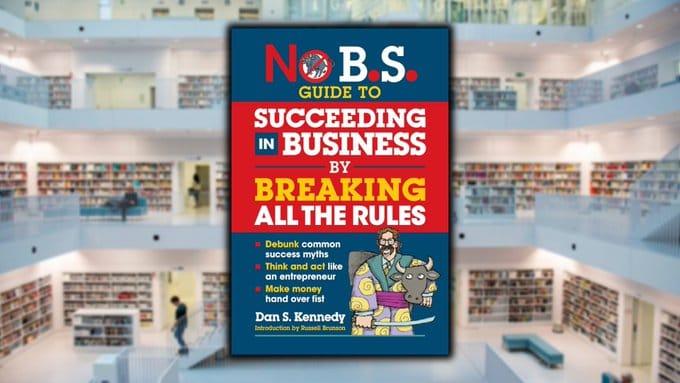
No B.S. Guide to Succeeding in Business by Breaking All the Rules, by Dan S. Kennedy:
There's always a way to succeed in life, no matter who you are or where you come from, but you're never going to find it by following the herd. If the herd knew how to achieve success and get everything they ever wanted, you wouldn't need this book.
Sample Quotes from the Book:
“Naturally, the 80 percent diligently obeying all the rules made for them and by them despise the 20 percent who defy some of the rules and the 1 to 5 percent who defy ALL the rules and get extraordinary, exceptional, infinitely better results.
If you listen to and conform to the 80 percent, you will be one of them. Here, I’m showing you how the top 1 percent to 5 percent think and act very, very differently, and get very, very different results.”
“In fact, some excellent career or business advice is to pick endeavors because of the type of person the endeavors will force you to become.
An early mentor used to urge people of very limited financial means to commit to the goal of becoming a millionaire, not so much for the money, he explained, but because of the people they would have to become, the positive characteristics and behaviors they would have to develop in order to achieve the financial benchmark.
He was widely misunderstood on this point and perceived by some to be a preacher of greed. What he meant, simply, was:
Big commitment to big goals build big people.”
“College graduates, on average, out-earn non-college graduates by six figures to, at most, a million dollars, lifetime. That IS an argument in favor of a college education, although a million dollars divided over 40 to 60 years of active work is not as gigantic as it sounds stated as a lump sum.
Look closer and here is what you will discover: If college actually prepares you for anything, it is for a job. College does not prepare you to be entrepreneurial, and it certainly does not prepare you to get rich.”
Read the Full Breakdown: No B.S. Guide to Succeeding in Business by Breaking All the Rules, by Dan S. Kennedy
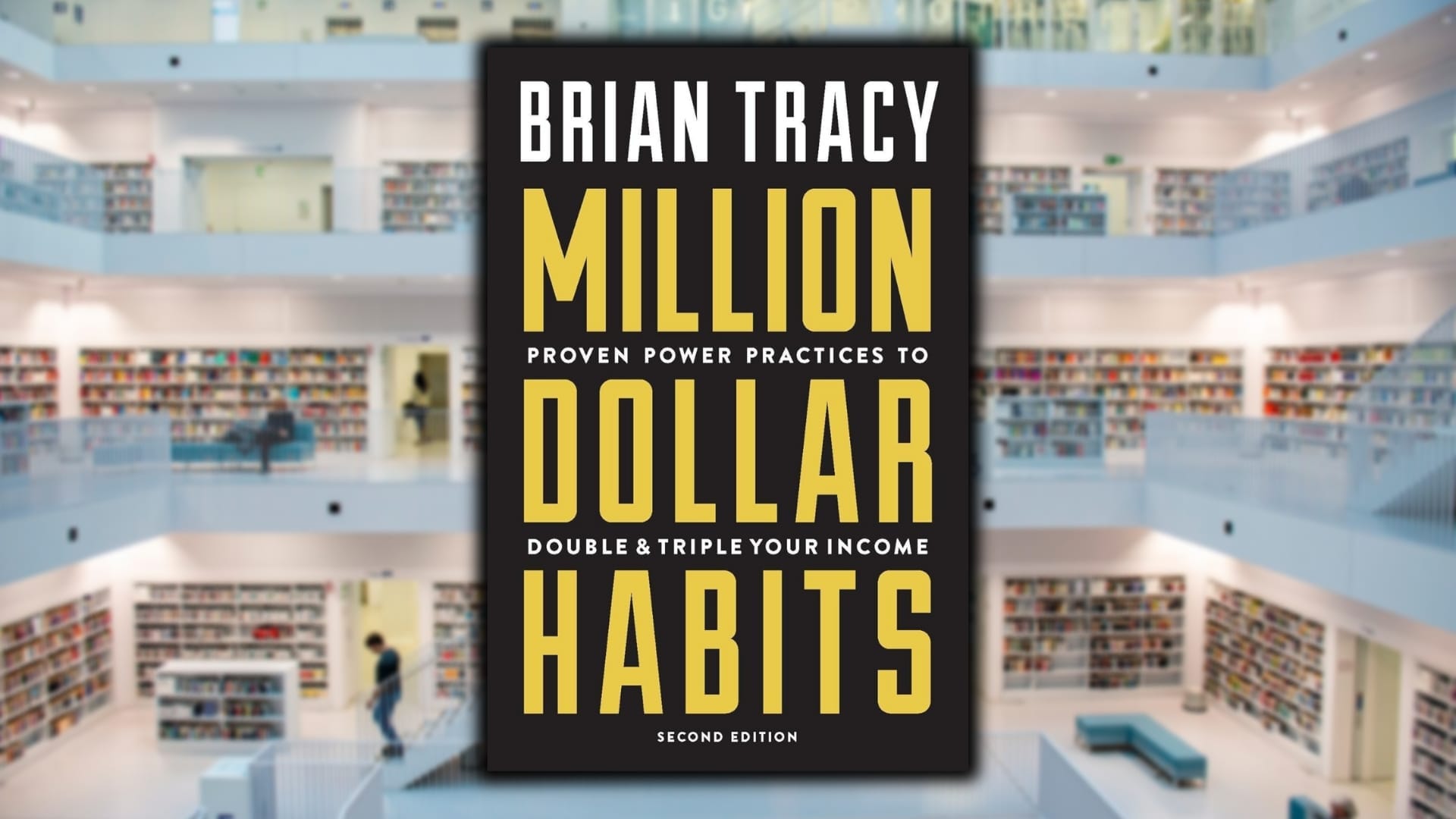
Million Dollar Habits, by Brian Tracy:
In this book, personal development legend Brian Tracy teaches you how to establish winning habits that will lead inevitably to the success and fulfillment you desire, while helping you actualize the potential you may never have known you had.
Sample Quotes from the Book:
“You came into this world with more talents and abilities than you could ever use. You could not exhaust your full potential if you lived 100 lifetimes.
Your amazing brain has 100 billion cells, each of which is connected to as many as 20,000 other neurons. The possible combinations and permutations of ideas, thoughts, and insights you can generate are equivalent to the number one followed by eight pages of zeroes. According to brain expert Tony Buzan, the number of thoughts you can think is greater than all the molecules in the known universe.
This means that whatever you have accomplished in your life to this date is only a small fraction of what you are truly capable of achieving.”
“Whatever your self-concept, your habit of thinking about money, or any other area of performance, very soon becomes your ‘comfort zone.’ Your comfort zone then becomes your greatest single obstacle to improved performance.
Once you get into a comfort zone in any area, you will struggle unconsciously to remain in that comfort zone, even though it may be vastly below what you are truly capable of achieving in that area.”
“Make developing new habits a regular part of your life. Always be working on developing a new habit that can help you. One new habit per month will amount to 12 new habits each year, or 60 new, life-enhancing habits every five years.
At that rate, your life would change so profoundly that you would become a whole new person, in a very positive way, in a very short period of time.”
Read the Full Breakdown: Million Dollar Habits, by Brian Tracy

Hell Yeah or No, by Derek Sivers:
This is, pound-for-pound, one of the wisest, most genuinely and authentically helpful books ever written, and it's just full of simple, profound mental models and sage advice to help guide your decisions and move you toward where you want to be in life.
Sample Quotes from the Book:
"When life or a plan feels ultimately unsatisfying, I find it's because I've forgotten to find the intersection of all three: what makes me happy, what's smart, and what's useful to others."
“Say no to almost everything. This starts to free your time and mind.
Then, when you find something you're actually excited about, you'll have the space in your life to give it your full attention. You'll be able to take massive action, in a way that most people can't, because you cleared away your clutter in advance.
Saying no makes your yes more powerful."
“We do so many things for the attention, to feel important or praised. But what if you had so much attention and so much praise that you couldn’t possibly want any more? What would you do then? What would you stop doing?”
Read the Full Breakdown: Hell Yeah or No, by Derek Sivers

The Pathless Path, by Paul Millerd:
A devastating crisis of meaning inspired Paul Millerd and many others to escape corporate slavery and build a real life for themselves in a universe teeming with more possibilities than could ever be imagined. This book is a call to adventure for you to join them.
Sample Quotes from the Book:
“The pathless path is an alternative to the default path. It is an embrace of uncertainty and discomfort. It's a call to adventure in a world that tells us to conform. For me, it's also a gentle reminder to laugh when things feel out of control and trust that an uncertain future is not a problem to be solved."
“So much of my identity had been connected with being a high achiever. Straight A's. Dean's List. McKinsey. MIT. When I was sick, I would have traded every last credential for a single day of feeling okay."
“‘Are those the only two options?’ I asked. 'Yes,' he replied. I listed a few other paths that he conceded were possible, but he added, 'I don't know anyone who has done that.'
Many people fall into this trap. We are convinced that the only way forward is the path we've been on or what we've seen people like us do. This is a silent conspiracy that constrains the possibilities of our lives."
Read the Full Breakdown: The Pathless Path, by Paul Millerd

The View from the Opposition:
No one's ideas are beyond questioning. In this section, I argue the case for the opposition and raise some points you might wish to evaluate for yourself while reading this book.
#1: Why Dolphins Are Smarter Than Humans
One of my favorite parts in The Hitchhiker's Guide to the Galaxy, by Douglas Adams, is when he said that humans always believed they were smarter than dolphins, because humans invented things like airplanes, skyscrapers, and supercars, while the dolphins just sat around hanging out in the water all day.
Naturally, according to Adams, the dolphins believed they were smarter than humans for exactly the same reason! Dennis does argue both points in the book, of course, but plenty of people see a book like this and think to themselves, "Man, what a waste of a potentially joyous human life! Why does anybody need $600,000,000?!" Why indeed.
The ancient Greek philosopher, Diogenes, would have sided with the dolphins on this one too. In one of my favorite stories, it's said that Alexander the Great once visited Diogenes to praise him, after hearing that he had disdained all physical manifestations of wealth - living on the street, owning nothing, like a dolphin (sort of). Alexander then asked Diogenes one question: "Is there anything that I, being the richest and most powerful man in the world, can you do for you, Diogenes?"
Diogenes responded that, yes, there was something that Alexander could do for him! "Could you please move over a little to the left? You're blocking my sun."
I retell that story here because, if you're as carefree and unbounded as Diogenes, you don't need Alexander's renown, Dennis's wealth, or literally anything else. You are completely self-sufficient, happy, and free in a way that neither one of the other men could ever be.
#2: Make the Pie Higher
I don't actually think George W. Bush is stupid, but he certainly has said some stupid things, now commonly referred to as Bush-isms. A few of my favorites before I get into my main point here:
"I think it's time for humanity to enter the solar system."
"The problem with the French is, they don't even have a word for entrepreneur!"
"They misunderestimated me."
Okay, so these are great, but he also said that "We ought to make the pie higher," which, even though it sounds ridiculous, is something he was right about. Once you untangle what the hell he was trying to say, of course.
It also happens to tie in with what Felix Dennis said about holding onto equity, and one of my favorite quotes by legendary speaker and personal development trainer, Zig Ziglar. It goes: "You can get anything you want in life, just as long as you help enough other people get what they want."
That's become something of a guiding philosophy of mine, and I believe it's a tremendously effective way of conducting business. You don't fight over the same small share of pie; you expand the pie. You make the pie higher, in Bush's words.
This is where I would push back a bit on Dennis's ideas, although I certainly understand where he's coming from. You should maintain an awareness of how potentially valuable equity is, and you don't want to give any of it up unnecessarily, but at the same time, you should work to arrange win-win-win relationships wherever you go, where everyone gets more, instead of a few people holding onto nearly everything.
On top of that, I love the idea of giving out credit and recognition as generously as humanly possible. You can accomplish so much more if you don't care who gets the credit, and you can become so much wealthier if you make the people around you wealthier as well.
"The test of a first-rate intelligence is the ability to hold two opposed ideas in the mind at the same time and still retain the ability to function.”
-F. Scott Fitzgerald

Questions to Stimulate Your Thinking:
The quality of your questions determines the quality of your life. That's also how you get the absolute most out of any book that you decide to read:
You ask great questions the whole time - as though the book was on trial for its life.
Here in this section are a few questions that can help guide and stimulate your thinking, but try to come up with your own additional questions, especially if you decide to read this book the whole way through...
#1:
#2:
#3:
#4:
#5:
#6:
#7:
#8:
#9:
#10:
"Judge a man by his questions, rather than by his answers."
-Voltaire
Action Steps:
So you've finished reading. What do you do now?
Reading for pleasure is great, and I wholeheartedly support it. However, I am intensely practical when I'm reading for a particular purpose. I want a result. I want to take what I've learned and apply it to my one and only life to make it better!
Because that's really what the Great Books all say. They all say: "You must change your life!" So here, below, are some suggestions for how you can apply the wisdom found in this breakdown to improve your actual life.
Please commit to taking massive action on this immediately! Acting on what you've learned here today will also help you solidify it in your long-term memory. So there's a double benefit! Let's begin...
#1: Calculate Your "Enough" Number
It's very, very hard to spend $5,000,000 a year. That's what Alex Becker says, anyway. For right now, I'll have to take his word for it. But it checks out, especially once you dig into the numbers, which is an extremely worthwhile exercise for everyone to do before they wind up wasting away in a cold, dark, deserted castle, surrounded by $600,000,000 that they'll never get to spend.
Here in this first Action Step, you're going to calculate your "enough" number - the amount of money you'd need to earn per month (or per year, or have in the bank), to feel financially secure. Like you had enough.
For context, my "number" is $50,000 per month. I'd say that I'm about a year or two away from hitting that number, but even now I don't feel deprived of anything. That $50K per month would cover basically every single thing I ever wanted, including charitable donations, savings and investments, etc. If I hadn't gone through this exercise though, my number would likely be much higher.
I won't spend a lot of time on this, but just break it down. Consider everything that most people lust over, and spend their time dreaming about acquiring. Even if you spend $10,000/month renting out a luxury apartment, $10,000/month on car payments for a Lamborghini Aventador, $1,000/week going out to expensive restaurants, $50,000/year buying expensive clothes, $100,000/year sending your kids to private school, $100,000/year going on expensive vacations, and add another, oh I don't know, $100,000/year for everything else, you're still "only" at $642,000/year in expenses. Granted, that's not nothing, and you still have things like taxes, contributing to your investment accounts, giving to charity, etc., but it's a LONG way off from $5,000,000/year. And here you have people running around thinking they have to be billionaires! It's madness!
My point is that I think you'll find, that if you run the actual numbers, you won't need (or want) as much as you think you do. But also, don't be modest! Don't hold back. Don't minimize your own desires and try and tell yourself that you don't want something if you actually do.
The world is rich, opportunity is abundant, and a lot of happiness can be found in the pursuit itself. It's possible to be happy, yet still not satisfied. You can find happiness in the here and now, and yet still chase big income goals and buy expensive stuff. They're not mutually exclusive, but it can be a difficult balance to strike, and especially if you don't know your numbers!
#2: Pick Your Basket
Everything else rests on that goals you set out to achieve, and so I took some extra space in that last Action Step to help you avoid wasting years of your life earning money that you don't need and will never spend. Next, we have another extremely important decision to make: how you plan on getting rich.
There are multitudes of ways to go about getting rich, and this isn't meant to be an exhaustive list, but in Rich Habits, Thomas C. Corley lays out several possible paths to riches that are available to you. You don't necessarily have to start a business like Felix Dennis did, although that can be the fastest route to take.
Patient saving and investing can make you rich, it's just that it takes an extremely long time, and you'll live through periods where your stock portfolio takes an absolute thrashing, and there's nothing you can do about it (or should do about it) except watch it drop, and wait for it to stabilize and bounce back.
Starting a business is that path that I chose, and it's a great one if you have a higher risk/anxiety tolerance, you have a strong sense of independence, and you don't mind working 100-hour weeks in the beginning, so you can work 10-hour weeks 10 years from now.
Many of these different paths to wealth can be combined with the others, especially in cases where one might develop high-paying, in-demand skills, and earn a great living working for someone else. Think: doctors, lawyers, cyber-security experts, programmers, etc. You might earn a degree or certification in one of these fields, live extremely cheaply in your 20s and 30s, and basically retire when you're 35.
There are a multitude of ways to get rich in this world, but the common thread when it comes to succeeding with any of them involves becoming extremely knowledgeable and competent in your field, keeping your living expenses low while you invest in income-producing assets, avoiding "lifestyle inflation," or succumbing to the pressure to upgrade your lifestyle just to keep up with your favorite influencer, and most importantly: committing to the process.
#3: Cultivate Delusional Self-Belief
One of the "secrets" to my own success is that I never once (ever) believed that I wouldn't make it. That I wouldn't ultimately be successful, no matter what. I believed (and believe) in myself so strongly, that I absolutely, categorically refuse to entertain the notion that I could fail at anything that's truly important to me.
I'm talking just a fucking DELUSIONAL level of confidence, self-belief, and optimism. It's a force - a power and a presence that I bring into my daily life that helps me bend the universe to my will, and dominate any field I choose to enter. You should hear the way I talk to myself! I may be all quiet and unassuming in person - interested in you and what you have to say (genuinely), and always willing to listen and learn. But when I'm by myself? Oh man. I am a force of fucking nature, within my own mind.
That's the kind of attitude you need to have as well. Naturally, you should still be polite and respectful to others, as I am. I dominate my own mind, I don't go around intent on dominating others. This is an inner game, one that I'm fucking winning no matter what.
This is another common theme in the lives of other unreasonably successful people. It's said that Steve Jobs had a reality distortion field surrounding him at all times, helping him achieve the seemingly-impossible and make dents in the universe. He's not the only one - not by a long shot - and if you want to be unreasonably successful, it's a habit of mind that you'd be well served to get into as well. If you want to be rich, there is no other way.
#4: Make a Self-Promise
One of the best ways to develop confidence and personal power is to make promises to yourself and keep them. It's quite literally some of the best advice that I, Felix Dennis, or anyone could ever give you. It's so fundamentally important to be able to trust yourself, rely on yourself, and know - deep, deep down - that you are a person that you can depend on.
That being said, if you're going to do this - if you're going to pursue this whole "getting rich" thing - you have to make an unbreakable promise to yourself that you will see it through to the very end.
Promise yourself that you will give this pursuit your absolute greatest effort, that you will never, ever give in, and that you will never, ever give up, unless of course you genuinely decide to stop the chase. End it when you've accomplished your objective, or when your true desires have changed, but not because it's hard, or because you're not seeing progress as fast as you'd like, or because other people are trying to convince you that it's not worth it.
If you're going to do this, go all the way. Promise yourself that you are going to give everything you have within you to make this happen, and hold onto this self-promise no matter what. Because if you can't trust even yourself, who can you trust?
#5: Die with Zero
There's one more book I'm going to recommend (sadly, it wasn't written in time for Felix Dennis to read it or benefit from it), and it's called Die with Zero, by Bill Perkins. The main idea behind the book is that you should seek an optimal balance between your time, your money, and your health across your lifespan.
It's all too easy to give up your time and sabotage your health when you're younger just to make money, and then to turn around and spend all that money trying to get your health back. It doesn't work. It's a trap, and it's one that's not easily avoided. The only way you're going to be able to avoid it successfully is to develop a keen awareness of your own life priorities, recalibrate them as needed, and check in every so often to make sure that you're still on track, that you're still living the life you want to live. It's so incredibly easy to drift off course, and remain off course until it's too late. Self-awareness and regularly reflection protects you from that.
Another key point in the book is that, obviously, you can't take any of it with you when you die. So you might consider aiming to "die with zero," spending and/or giving away all your net worth while you're alive. That doesn't mean draining your retirement funds just so you can take an extravagant vacation, it's more so about enriching the quality of your and your family's lives in the here and now, when your money can do the most good. Perkins makes the additional point that your children are likely to be earning more money as they get older anyway, so when your money could really benefit them is today (or at least soon), as they attempt to get businesses off the ground, accumulate life experiences, etc. You don't have to be dead to give it all away.
The Action Step here is to name at least one "living beneficiary" of your estate (it could even be yourself), and help them enjoy their lives now, while at the same preparing them to have a healthy and wealthy future. Figure out the optimal balance of time spent working, time spent keeping yourself healthy, and time spent enjoying your life, and structure your life in keeping with your goals. And always remember, money can buy happiness if you spend it on others, and if you don't believe that money can buy happiness, you haven't given enough away.
"The path to success is to take massive, determined action."
-Tony Robbins


About the Author:
Felix Dennis (1947 – 2014) was the colourful publishing entrepreneur whose company, Dennis Publishing, owns many successful titles including flagship publication The Week. A regular fixture in the Sunday Times rich list Dennis travelled a long way since the poverty of his childhood in a south London suburb. He first gained notoriety as one of the editors of the 60s satirical magazine, Oz, and as such was prosecuted for obscenity in an infamous trial in 1971 (he was subsequently acquitted at the High Court of Appeal). His business interests and flamboyant party lifestyle left little room for poetry, though he’d always read and enjoyed it since a boy. However a spell of serious illness in 1999 found him taking stock and poetry suddenly flooded into his life. Since his first poem scribbled on a post-it note in hospital he wrote over a thousand and published six best-selling collections. As in so many aspects of his life, his involvement in the poetry world was unconventional: volumes of contemporary poetry are supposed to be slim – his often run to over two hundred pages. Collections of modern poetry, especially first collections, do not sell over ten thousand copies – his have and are being reprinted. First time poets don’t go on national reading tours – Dennis did and even appeared with members of the Royal Shakespeare Company on the stage of the Swan Theatre in Stratford.
Larynx been lived in
Additional Resources:
This Book on Amazon:
How to Get Rich, by Felix Dennis