
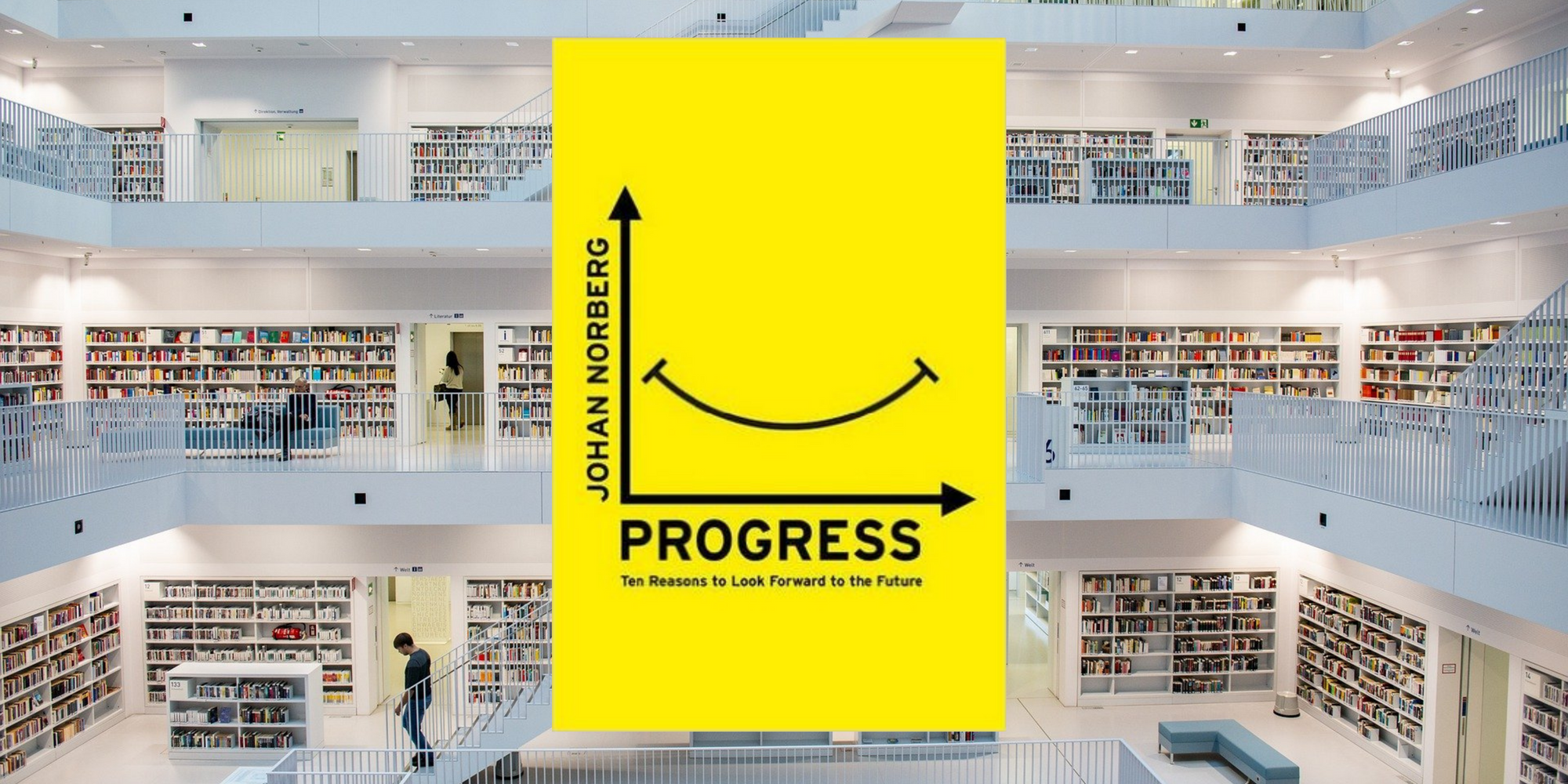
Summary:
The world's on fire, right? Death and destruction everywhere, misery rampant, bodies littering the streets? Wrong, wrong, wrong! We are living in the safest, healthiest, most peaceful, most literate, most cohesive, and happiest time in our civilization's history.
The problem is that nobody has noticed.
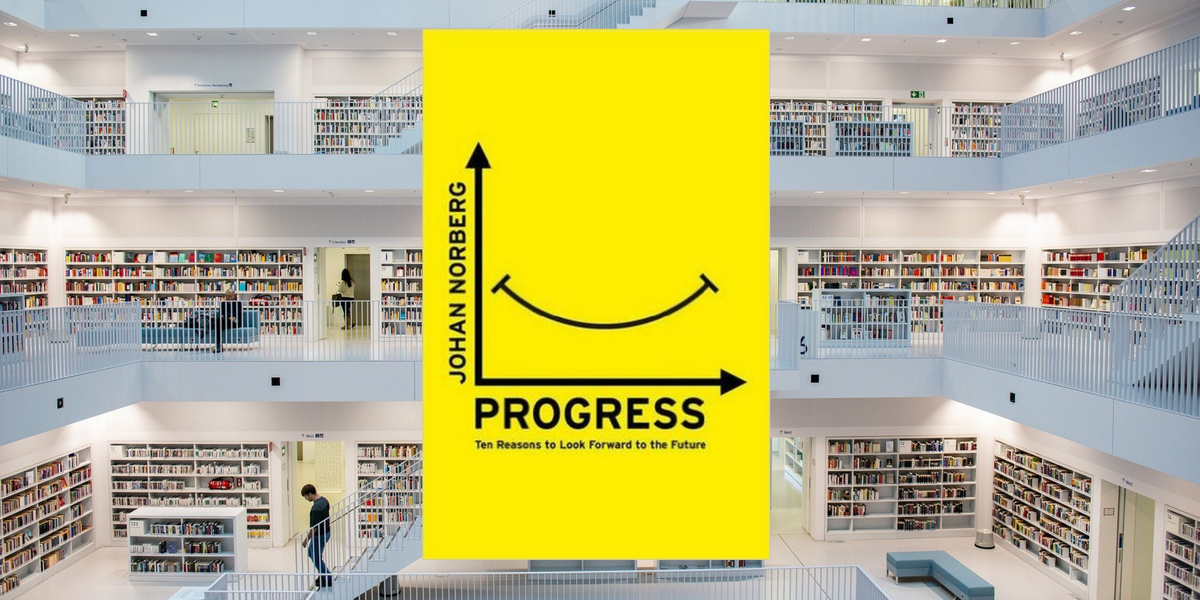
Progress is a catalog of all the spectacular improvements in living standards and well-being that humanity has achieved for itself, particularly after the year 1800. Norberg runs down the list - food, sanitation, poverty, violence, equality, etc - and explains how 2.6 billion people have received access to an improved water source since 1990, how the poorest countries in the world in the 1950s were richer than the richest countries in the world were in 1800, and so much more.
The progress that we've made is nothing less than astonishing - I mean, 'astonishing' doesn't even do it for me to explain how stupendously insane and ridiculous the improvements we've made to global human well-being and happiness have been. We have extreme challenges ahead of us of course, hundreds of millions more people to lift out of extreme poverty, but we've also overcome extreme challenges. Not to recognize this is to put future progress at risk.
That being said, Norberg believes that human beings have reached escape velocity. We're poised to break the cycle of ignorance and pain that has kept humanity down in the trenches for hundreds of thousands of years. And we're doing it right now, today, in so many different ways, and this is being facilitated by the most diverse and broad-based group of people ever to attack a social problem. Poverty, death, violence, and misery were always humanity's problems, and we're finally coming together to solve them.
Not only that, but we're succeeding! So why doesn't it feel that way? Well, Norberg points to several reasons, foremost among them our natural human tendency to focus on the negative. Indeed, those of us in our evolutionary past who didn't see the negative and the danger would never have lived to see the progress we've achieved today. So these cognitive biases used to serve us in the past, but they simply don't anymore.
Another reason he points to is that when we watch the news, we're watching the worst of the worst things that have happened that day. We see the plane crashes, but we don't see the 110,000 planes that didn't crash that day. We see the racial- and gender-driven tensions, but we don't see the billions of people who live in peaceful harmony. Ordinary humans living in peace and happiness don't make the news, just like you don't tell the story of how you got home from work unless something really strange happened on the way.
It's evident from Norberg's work that humanity solves more problems than it creates - when it's given the freedom to do so. Humanity is just...awesome. We're gonna make it; we're going to persevere, and we're going to keep making gains, but we need to push hard enough - and smart enough - so that everyone has access to the incredible prosperity for which we've collectively worked and suffered.

Key Ideas:
#1: Peace is a modern invention. If you're looking for some paradisal epoch of human history where everyone was happy and well-fed, where people lived well into old age, and violence was rare, you can stop looking. Because it doesn't exist. Now is the best time to be alive, and it's getting better all the time.
#2: Fear is one of the biggest problems we face, because when human beings get scared, they turn inward. They look for some powerful savior, often a dictator, to come and rescue them from their perceived enemies, instead of reaching outward and connecting more deeply with those from whom they have the most to gain: their neighbors. When people believe in the future, they will invest in the future.
#3: One less-measurable but still worthwhile sign of progress is that nowadays racists and warmongers for the most part have to stay hidden. The public backlash would be so severe that you cannot openly identify as a racist, or a sexist, and keep your job or position for long. That's progress!
As well, leaders used to be able to just declare war on whomever they felt like, whenever they felt like it. This is no longer the case. They can no longer say, "I came, I saw, I conquered." Now, it’s “I came, I saw, he attacked me while I was just standing there looking, I won.”
#4: We have to look behind the statistics because they don't always tell the whole story. People often point to rising cancer rates as an emerging disaster and yes, it's a horrible, horrible disease that has caused humanity tremendous pain. But...in the time before life expectancy started increasing dramatically in the 19th and 20th centuries, people didn't live long enough to get cancer. Of course, you can lie with statistics. But it's much easier to lie without them.
#5: With the success - and failures - of globalization, we have come to see that the success of one country relies on the success of every other country. No longer can we face our problems alone.
We need each other, and in the past few hundred years, we have seen evidence that humanity solves far more problems than it creates. Humanity has reached escape velocity, but we can't have any single country dragging us all down. We rise and fall together.
#6: We are often blind to the progress that has been made, because human beings come equipped with dozens of cognitive biases that prevent us from always seeing the world accurately.
Among them, we pay more attention to bad news than we do good news. This had the evolutionary advantage of alerting us to dangers, but now it is a vice.
Criticizing the world makes the critic seem more morally engaged - another cognitive bias - but we need people who promote the good. The good exists, it exists all around us, and we need to get better at recognizing it - and repeating its causes.

Book Notes:
“If you are looking for a monument, look around you.”
Frightened people don’t ask for more freedoms and opportunities, but instead for more protection. This allows authoritarianism to flourish. So, a big part of what we need to do is fight fear.
At the time of this writing, there has never been a famine in a democracy.
“Since 1990, 2.6 billion people have gained access to an improved water source, which means that 285,000 more people got safe water every day for twenty-five years. Depending on how fast you read, another 300 to 900 people will have got access to safe water for the first time before you have reached the end of this chapter."
“Before the year 1800, not a single country in the world had a life expectancy higher than forty years.”
“In this era of globalization, the most important factor behind a country's success is the success of other countries."
"Even a country such as Haiti, which is one of very few countries that is poorer today than it was in the 1950s, has reduced its infant mortality rate by almost two-thirds. Haiti actually has lower infant mortality than the richest countries on the planet had in 1900."
If one tree grows big enough, it can provide shade for many smaller ones.
“People who believe in the future also invest more in the future.”
“Peace is a modern invention.”
Leaders now can’t just start a war because they were insulted, or had something to gain. Now, it’s “I came, I saw, he attacked me while I was just standing there looking, I won.”
“If the tailor goes to war against the baker, he must henceforth bake his own bread.”
“Amazingly, a modern car in motion emits less pollution than a 1970s car did in the parking lot, turned off, due to gasoline vapor leakage."
The cancer rates are rising because in the past, people didn’t live long enough to get cancer.
“Literacy is what’s known as a classical relational good - the more people who can read and write, the more you stand to benefit from being able to read and write. And if a sufficient proportion is literate, business and culture is transformed so that it becomes punishingly difficult to participate in society if you are illiterate."
"Today, only fourteen percent of the global adult population can't read and write, whereas in 1820 only twelve percent could."
“A child born today is more likely to reach retirement age than his forebears were to live to their fifth birthday.”
“According to an ambitious attempt to measure poverty over the long run, with a $2 a day threshold for extreme poverty, adjusted for purchasing power in 1985, ninety-four percent of the world’s population lived in extreme poverty in 1820, eighty-two percent in 1910 and seventy-two percent in 1950.19 But in the last few decades, things have really begun to change. Between 1981 and 2015 the proportion of low- and middle-income countries suffering from extreme poverty was reduced from fifty-four per cent to twelve per cent.”
“Humanity has reached escape velocity.”
Inscription on a stone from Chaldea, 3800BCE: "We have fallen upon evil times and the world has waxed very old and wicked. Politics are very corrupt. Children are no longer respectful to their parents."
Forty million planes take off every year and almost every single one of them lands safely.
Everything bad happens in an instant, whereas massive, positive change, occurs gradually over time.
“We don’t tell our families how we got home from work unless something really strange happened along the way.”
“In a more dangerous era, the cost of overreacting to a perceived threat was much smaller than the cost of underreacting. Those who were more worried and dissatisfied survived and spread their genes to us. We are very interested in everything dangerous because people who weren’t would have died by now.”
“Complaining about problems is a way of sending a signal to others that you care about them, so critics are seen as more morally engaged."
"Criticizing the present is a way of competing with our rivals and contemporaries, whereas we can easily praise past generations, because they are not our competitors."
“Humanity solves more problems than it creates, when it gets the freedom to do so.”
“Of course it’s possible to lie with statistics, but it’s easier to lie without it.”

Action Steps:
So you've finished reading the book. What do you do now?
#1: Look for the good.
You don't have to go very far to run into evidence of inequality and atrocities, but finding out about something good that's happened sometimes takes a little more work. This isn't because it's rarer, but because we're more attuned to look for danger. This kept us alive when humanity was growing up (an ongoing process), but now it's a liability. If you don't actively look for the good, there's a danger that you're going to come away with a skewed perception of the world, and that would be a real tragedy.
#2: Encourage someone else to look for the good.
Because human beings tend to stick together in groups, negativity can spread quickly, even when it's unwarranted. We can become too insulated, yelling into an echo chamber, and we can all miss the good. So whenever you can, encourage someone else to notice all the progress we've made together. This is how upward trajectories start.
#3: Go on a news fast.
News channels might occasionally toss you a story about a litter of puppies that was rescued by concerned school-teachers who were just taking a break from trying to find a cure for cancer, all while going to night school to - you get the idea.
But their business is advertising, and advertisers want eyeballs. They know that eyeballs are attracted to plane crashes and terrorist attacks and shootings, and so that's exactly what they're going to show you. I'm not saying it's not true, I'm just saying that it's not even close to the full story.
They won't tell you about the 285,000 more people who have received access to clean, safe drinking water every single day for the last twenty-five years, but they will tell you how the world is going to hell and that they have the full story after the commercial break. So maybe take a break yourself for a little while and go do something else?
#4: Check your sources.
When reading nonfiction, listening to the news, or, really, consuming anything that was written with the aim of changing your point of view on an important subject, it's best to find out as much as you can about where the author got their information.
It just so happens that the author of this book (Progress) is a Senior Fellow at the Cato Institute, a well-known libertarian think tank. What does this mean? Well, investigate for yourself. Maybe it means nothing, and they are rated highly for their fact-checking. But what have you heard contradicting the findings presented here?
For the longest time, it was the tobacco industry that was funding the research studies that "found out" that smoking didn't cause cancer. So, when we're dealing with something as important as the fate of humanity, it's important that you get your facts right.
#5: Use Effective Altruism as a guide to help you choose a good cause or charity to get involved with.
Effective Altruism refers to the relatively recent movement towards fact-based giving. It's a movement dedicated to identifying the most effective charities and getting people to ask questions about where their charity dollars are going. You can affect powerful change out there in the world, but you want to do your research first and find out whether or not you're attacking the right problem.
#6: Focus on yourself first.
You won't be able to give much money away if you're poor. Similarly, you won't be able to serve as a supportive rock for the people and community you care about if you yourself are struggling. So, as much as it sounds selfish, you have to focus on yourself first. A large tree can provide shade to many other smaller trees, and there's a reason why the flight attendants ask you to put on your own oxygen mask first.
#7: Give what you can.
Once you've set yourself up in a good position to help people, figure out what you can give. Maybe you can't give away a bunch of money now, but you can donate your time. Or perhaps you're a busy professional working lots of hours but you've got a chunk of cash that's burning a hole in your pocket. Either way, figure out what you can give, sustainably, and then give it. Now is not the time to hold back. Not when there are still so many people who need our help.
About the Author:
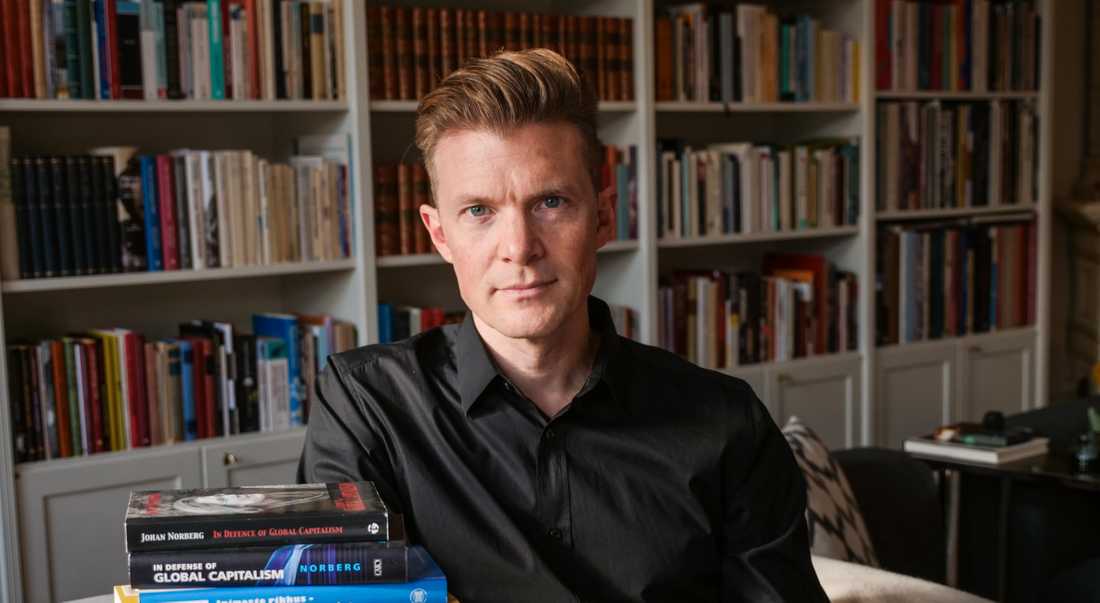
Johan Norberg is a Swedish author and historian of ideas, devoted to promoting economic globalization and what he describes as classical liberal positions. He is arguably most known as the author of In Defense of Global Capitalism and Progress: Ten Reasons to Look Forward to the Future.
Additional Resources:
This Book on Amazon:
If You Liked This Book:
Enlightenment Now, by Steven Pinker
Doing Good Better, by Will MacAskill