
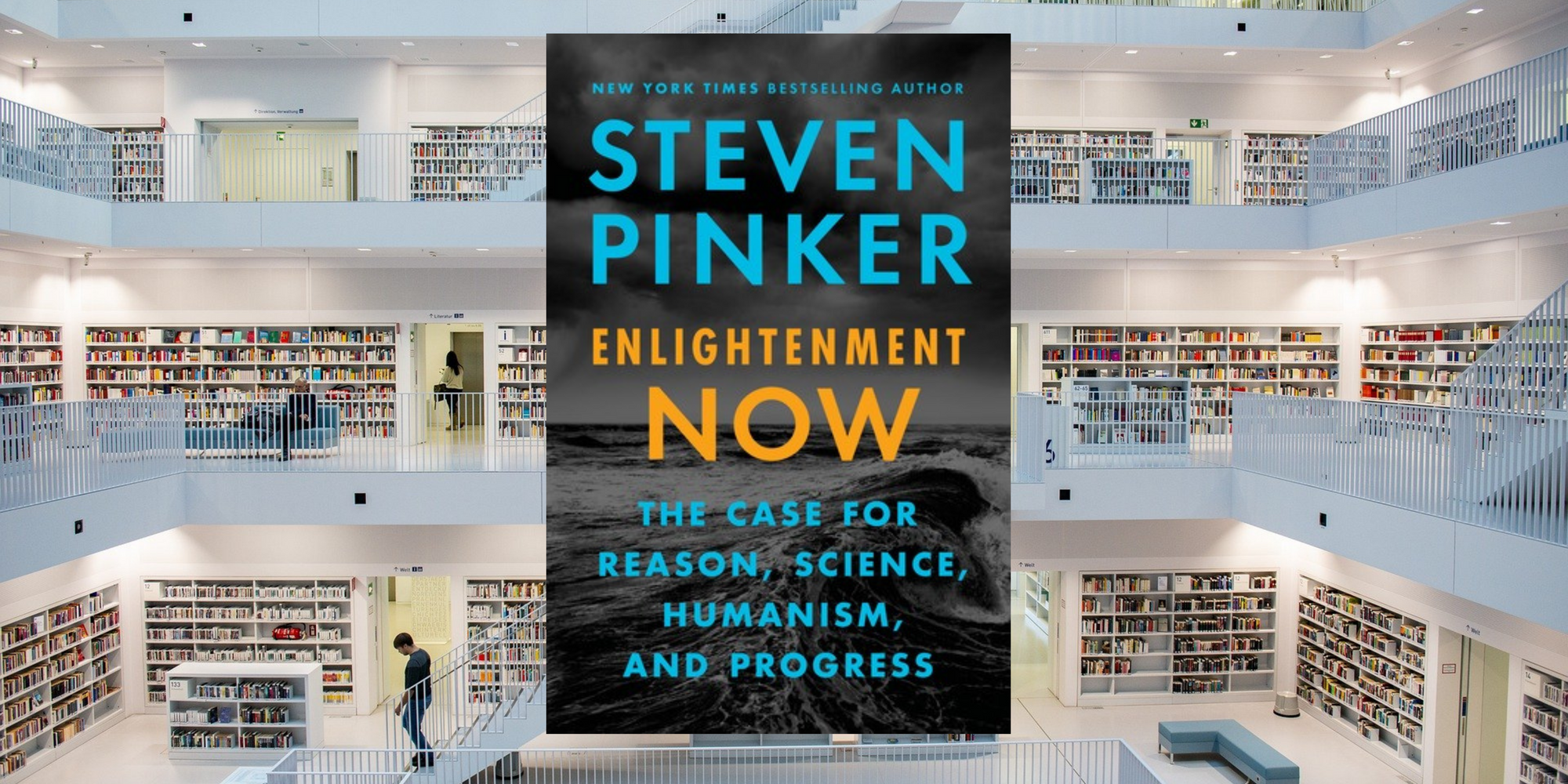
Summary:
Is the world getting worse? Or better? If you don’t know the answer, what are your first instincts? If you only watched the news, what would you be led to believe?
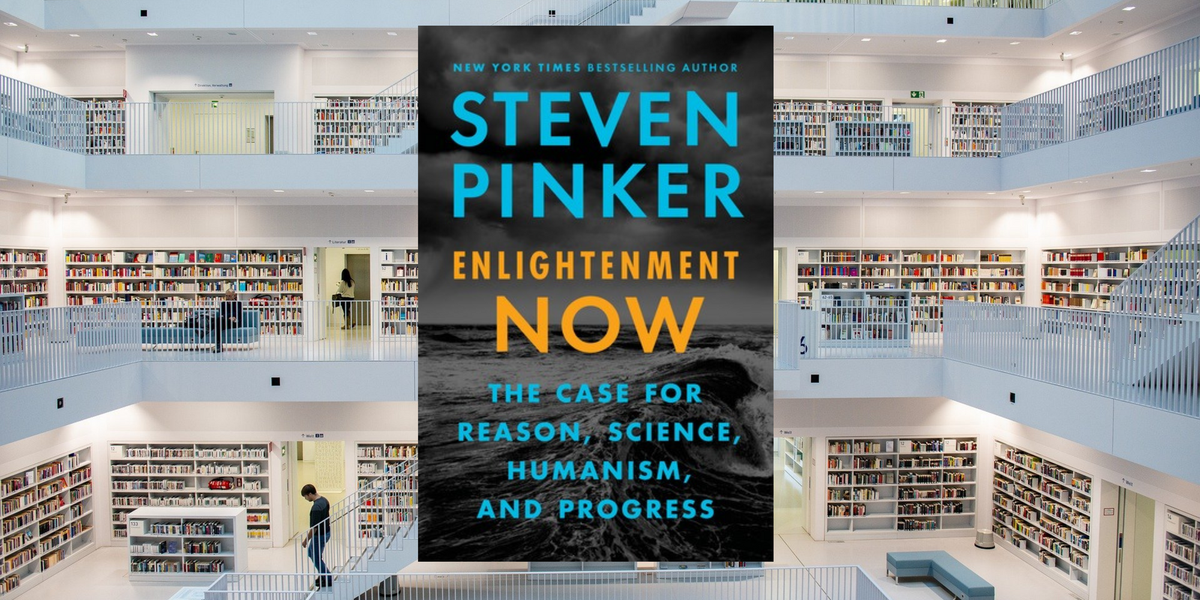
The happy truth is that today is the greatest time in human history to be alive. Don’t believe me? Well, in Enlightenment Now, Steven Pinker points out that:
"If news outlets truly reported the changing state of the world, they could have run the headline 'Number of People in Extreme Poverty Fell by 137,000 Since Yesterday' every day for the last 25 years. We live in a world not just with a smaller proportion of extremely poor people but with a smaller number of them, and with 6.6 billion people who are not extremely poor."
This is a pretty astonishing effect. But the real story here is the cause of that effect. Progress doesn’t just “happen.” Progress - real, sustained progress - is a collective human achievement, and in the pages of Enlightenment Now you will learn the true cost of that progress. It wasn’t inevitable, it wasn’t easy, and it didn’t come without extreme sacrifice.
Since the Age of Enlightenment (also known as the Age of Reason, taking place in the 17th-19th centuries), we have saved billions of lives through scientific advances in agricultural production, health interventions, and improved sanitation; we have ensured the rights and freedoms of billions of people who had before been silenced (still working on that one, of course); we have established global networks of cooperation that are responsible for some of humanity’s greatest achievements, and we’ve laid the groundwork for every possible opportunity, freedom, and success that our future generations will ever experience. We did this with ideas, passion, teamwork, drive, self-discipline, reason, energy, and everything else that makes humanity great.
Steven Pinker does an excellent job here in this book chronicling human progress, identifying where we can do and be better, and examining some of the beliefs and attitudes that are still holding us back. This book is a crushing corrective to those cowardly pessimists who say that humanity is doomed. Humanity is just getting started, and this book will show you why.

Key Ideas:
#1: The Age of Enlightenment (17th-19th centuries) was the wellspring of many of our most astonishing advances in human freedom, health, happiness, longevity, and on and on. The ideas generated by Enlightenment thinkers like Spinoza, Hume, Adam Smith and a multitude of others are directly responsible for a lot of the prosperity we’re witnessing today.
#2: Along almost every single measure of human progress (climate change is its own special category, with spectacular wins and losses in that area), today is the greatest time in history to be alive. Human beings live longer, in freer societies, and with access to greater opportunities than any other period in history.
If you’re looking for some Golden Age where everyone was rich and happy and peaceful - it doesn’t exist. Today isn’t perfect, but it’s pretty damn good. We’re making progress, and we can make more progress, as long as people continue to think of the continued survival and prosperity of humanity as a worthy goal.
#3: People pay more attention to bad news than good news. This makes evolutionary sense, of course, because paying attention to potentially harmful things in your environment could keep you alive. While still true, of course, our inborn biases toward seeking out negative information blind us to all the incredible progress being made, and causes many people to believe that the world is getting worse, when in fact it’s getting substantially better.
#4: Even though things are better today than they ever have been before, no form of progress is inevitable. We can’t just surf the rising tide of progress; rather, we have to call attention to the things we’re doing that are working, so that we can do more of those things. Yes, pay attention to the negative, but we can’t get caught up in it. We have to look for the good, and look for ways to create more of it.
#5: There is an incredible amount of untapped potential at “the bottom.” Among the bottom billion, there are at least, statistically, a million people with a genius-level IQ who are not being given the opportunity to contribute to the health and happiness of the world. IQ isn’t everything, of course, but that’s just an example of what we’re letting go to waste.
#6: The goal of progress cannot be to increase happiness indefinitely, but there is plenty of unhappiness that can be reduced. And there is no limit to how meaningful our lives can become.
Also, we need to remember that happy lives and meaningful lives can be mutually exclusive. Doctors and nurses working for humanitarian relief organizations like Doctors Without Borders could not be called “happy,” given what they witness every day, but no one can deny that they lead exceptionally meaningful lives.
#7: “If a society is functioning halfway decently - if the streets aren't running with blood, if obesity is a bigger problem than malnutrition, if the people who vote with their feet are clamoring to get in rather than racing for the exits - then its current institutions are probably a good starting point."
#8: Everything not forbidden by the laws of nature is achievable, given the right knowledge.
#9: “Nothing in human nature prevents a person from being a proud Frenchman, European, and citizen of the world, all at the same time."

Book Notes:
It’s hard for people to imagine things getting much better, but very easy to imagine things getting much worse. Yet, things ARE getting much better.
How much better or worse is it possible to feel? Can we be much happier, or much worse off than we are now? What are the upper and lower limits?
We’re more likely to mistake the harms around us for how low we have fallen, rather than how high our standards have risen.
“If you’re reading this, you are not dead, starving, destitute, moribund, terrified, enslaved, or illiterate, which means that you're in no position to turn your nose up at these values - or to deny that other people should share your good fortune."
The graph displaying Gross World Product has nothing for about two thousand years...and then it goes straight up. Literally.
The Paradox of Value: When an important good becomes plentiful, it costs far less than what people are willing to pay for it.
"If news outlets truly reported the changing state of the world, they could have run the headline 'Number of People in Extreme Poverty Fell by 137,000 Since Yesterday' every day for the last 25 years. We live in a world not just with a smaller proportion of extremely poor people but with a smaller number of them, and with 6.6 billion people who are not extremely poor."
"The point of calling attention to progress is not self-congratulation but identifying the causes so we can do more of what works."
"The economist Paul Romer distinguishes between complacent optimism, the feeling of a child waiting for presents on Christmas morning, and conditional optimism, the feeling of a child who wants a treehouse and realizes that if he gets some wood and nails and persuades other kids to help him, he can build one."
Since there has been so much improvement in the past, why do we think that there will be only deterioration in the future?
"Among the world's bottom billion are a million people with a genius-level IQ. Just think what the world would look like if their brain power were put to full use!"
"If religion were a source of morality, the number of religious wars and atrocities ought to be zero. And obviously atheism is not a moral system in the first place. It's just the absence of supernatural belief, like an unwillingness to believe in Zeus or Vishnu. The moral alternative to theism is humanism."
"The first step toward wisdom is the realization that the laws of the universe don't care about you. The next is the realization that this does not imply that life is meaningless, because PEOPLE care about you, and vice versa. You care about yourself, and you have a responsibility to respect the laws of the universe that keep you alive, so you don't squander your existence. Your loved ones care about you, and you have a responsibility not to orphan your children, widow your spouse, and shatter your parents.
And anyone with a humanistic sensibility cares about you, not in the sense of feeling your pain - human empathy is too feeble to spread itself across billions of strangers - but in the sense of realizing that your existence is no less cosmically important than theirs, and that we all have a responsibility to use the laws of the universe to enhance the conditions in which we all can flourish."
The benefits of capitalism can literally be seen from space. Of course, so can the drawbacks.
A typical civil war costs a country $50 billion.
Every cell phone adds $3,000 to the annual GDP of a developing country.
Income equality is not a fundamental component of well-being. The fact that others have more doesn’t de-value what you have. Freedom from hunger, freedom from preventable disease, freedom from oppression - these are all fundamental components of well-being.
“Inequality itself is not morally objectionable; what is objectionable is poverty.”
Harry Frankfurt: “From the point of view of morality, it is not important everyone should have the same. What is morally important is that each should have enough.”
A narrow focus on inequality can be destructive if it distracts us into bringing down the rich, instead of figuring out how to lift people out of poverty.
Wealth is not a finite resource.
People often conflate inequality with unfairness, which are definitely not the same thing.
People don’t necessarily mind unequal distributions, and even sometimes favor them, as long as they feel that the allocation is fair.
Historically, it has only been wars and pandemics that reduce income inequality. Be careful what you wish for.
“The human moral sense is not particularly moral; it encourages dehumanization and punitive aggression.”
“The moral sense can also sanctify pointless displays of sacrifice. People esteem others according to how much time or money they forfeit in their altruistic acts rather than by how much good they accomplish.”
“While humans do have public sentiments, it’s unwise to let the fate of the planet hinge on the hope that billions of people will simultaneously volunteer to act against their interests.”
“Something is uniquely unsettling about the thought of a human being who wants to kill you, and for a good evolutionary reason.”
The most damaging effect of terrorism is countries’ overreaction to it.
Recommended media policy for rampage shootings: “Don’t name them, don’t show them, but report everything else.”
Democracy should be a question not of who should rule, but how to dismiss bad leaders without violence.
Bigoted Google searches tend to come from regions with older and less-educated populations.
No form of progress is inevitable.
“An expansive cafeteria of opportunities to enjoy the aesthetic, intellectual, social, cultural, and natural delights of the world, regardless of which ones people put on their trays, is the ultimate form of progress."
“It wasn’t long ago that the average American man had two stages of life: work and death.”
The average American now retires at age 62. One hundred years ago, the average American died at age 51.
Adam Smith: “The real price of every thing is the toil and trouble of acquiring it.”
Single and working mothers today spend more time with their children than stay-at-home married mothers did in 1965.
A century ago, if family members moved to a distant city, one might never hear their voices or see their faces again.
Many people today have the luxury of failing to appreciate their good fortune.
Happy lives and meaningful lives can be mutually exclusive.
The goal of progress cannot be to increase happiness indefinitely, but there is plenty of unhappiness that can be reduced. And there is no limit to how meaningful our lives can become.
People in every country underestimate the proportion of their compatriots who say they are happy, by an average of 42 percentage points.
The social critic’s standard formula for sowing panic: Here’s an anecdote, therefore it’s a trend, therefore it’s a crisis.
The label “depression” today may be applied to conditions that in the past were called grief, sorrow, and sadness.
Betteridge’s Law of Headlines: “Any headline that ends in a question mark can be answered with the word ‘no’.”
The dire warnings about plagues of loneliness, suicide, depression, and anxiety don’t survive fact-checking.
A modicum of anxiety may be the price we pay for the uncertainty of freedom.
Women are not gaining in happiness as quickly as men, but that could be partly due to the fact that freedom brings on a little bit of increased anxiety.
“Recall that people who feel they lead meaningful lives are more susceptible to stress, struggle, and worry."
“If the hands of a clock point to a few minutes before midnight for 72 years, something is wrong with the clock.”
Since the nine nuclear states won’t be giving up their nuclear weapons any time soon, we should instead figure out what we’ve done right over the last 8 decades so we can do more of that.
Anything that reduces the risk of war also reduces the risk of nuclear war.
“The claim that 'everything is subjective' must be nonsense, for it would itself have to be either subjective or objective. But it can't be objective, since in that case it would be false if true. And it can't be subjective, because then it would not rule out any objective claim, including the claim that it is objectively false."
Identity-protective cognition can lead people to reject sound claims on the basis that, should they reject them, they will gain esteem in their peer group.
“Preposterous beliefs are more effective signals of coalitional loyalty than reasonable ones."
"A real society comprises hundreds of millions of social beings, each with a trillion-synapse brain, who pursue their well-being while affecting the well-being of others in complex networks with massive positive and negative externalities.”
“If a society is functioning halfway decently - if the streets aren't running with blood, if obesity is a bigger problem than malnutrition, if the people who vote with their feet are clamoring to get in rather than racing for the exits - then its current institutions are probably a good starting point."
The beauty of reason is that it can always be applied to understand failures or reason.
To say that science gave us both vaccines and nuclear weapons is to say that architecture gave us both museums and gas chambers, and doesn’t say anything about the fact that we’d rather have understanding and know-how instead of ignorance and superstition.
A society without historical scholarship is like a person without memory: deluded, confused, easily exploited.
Everything not forbidden by the laws of nature is achievable, given the right knowledge.
“Nothing in human nature prevents a person from being a proud Frenchman, European, and citizen of the world, all at the same time."
An anecdote is not a trend, and the fact that something is bad today doesn’t mean that it was better in the past.

Action Steps:
So you've finished reading the book. What do you do now?
#1: Consult OurWorldinData.org, instead of the news.
The news is all about advertising revenue. News stations need people to watch, so they can charge more money for ads, and to get people to watch, they have to show blood. The old newspaper adage applies here: “If it bleeds, it leads.” Knowing this, what do you think they’re going to show you?
Here, check out the numbers for child labor globally, from 2000-2012. It shows a DROP from 23% in 2000, to 16.7% in 2012. Has it been eradicated? Of course not, but that is just one of many instances of the incredible progress we’ve made. But if you watch the news (especially if, say, it rose from 16.6-16.7% that year or something), the headline would be “Child Labor Grows to 16.7% Annually!!!”
#2: Research (and practice) Effective Altruism.
Effective Altruism is a movement that advocates measuring the true impact of our charitable activities. For example, you might think (like I did) that simply providing kids with textbooks would improve literacy; I mean, it’s a reasonable assumption. But it turns out that de-worming programs do the most good in the most vulnerable areas, and keep kids in school who would otherwise have to skip class because they were sick.
#3: Give what you can.
If you’re struggling financially, don’t feel guilty about not donating to charity. It’s important to help yourself first, so that you’re in a better position from which to help others. That being said, if you’re doing pretty well, or at least have all your basic needs met, commit to giving away more of what you earn to people who really need it. Donating 5-10% of your income isn’t unreasonable, and more would make you a freaking saint. If you don’t need it, there’s someone out there who does.
#4: Take an interest in the global community.
Apathetic, uninformed citizens are the precondition for the spread of evil in our institutions. When no one is paying attention, that’s when slimy politicians (not all politicians are slimy, of course) slip devious shit past us and make us complicit in their lies and corruption. So make an effort to learn more about your government, its representatives, and the major governments of the world. Keep in mind that they are fallible human beings, prone to mistakes and shortsightedness, but also make sure they don’t pull any fast ones.
#5: Appreciate your good fortune.
If you’re reading this, you have internet access, you know how to read, you probably have excellent taste (just kidding), and there’s probably no one charging over the next hill to exterminate you. Stack on top of that the astronomically unlikely fact of you being alive at ALL, and you’ve got plenty to be grateful for. Never, ever, ever lose sight of that.
#6: Decide to what extent you want your life to be happy or meaningful.
As we discussed earlier, happiness and meaning can be mutually exclusive, at least to a certain extent. By which I mean that if you’re ministering to the global poor, malnourished, and disenfranchised, and you’re doing this saintly work every single day of your life, your happiness is likely to be somewhat compromised. Simply by virtue of the suffering you have to witness every single day. So maybe you aren’t “happy,” but your life is incredibly meaningful.
That being said, however, there’s nothing wrong with being happy! The Earth is rich, wonder is everywhere, and happiness is available to a greater number of people than ever before. So don’t deprive yourself of happiness out of guilt. Rather, decide exactly how meaningful you want your life to be, and how happy you want your life to be, and then go make it a reality.
About the Author:
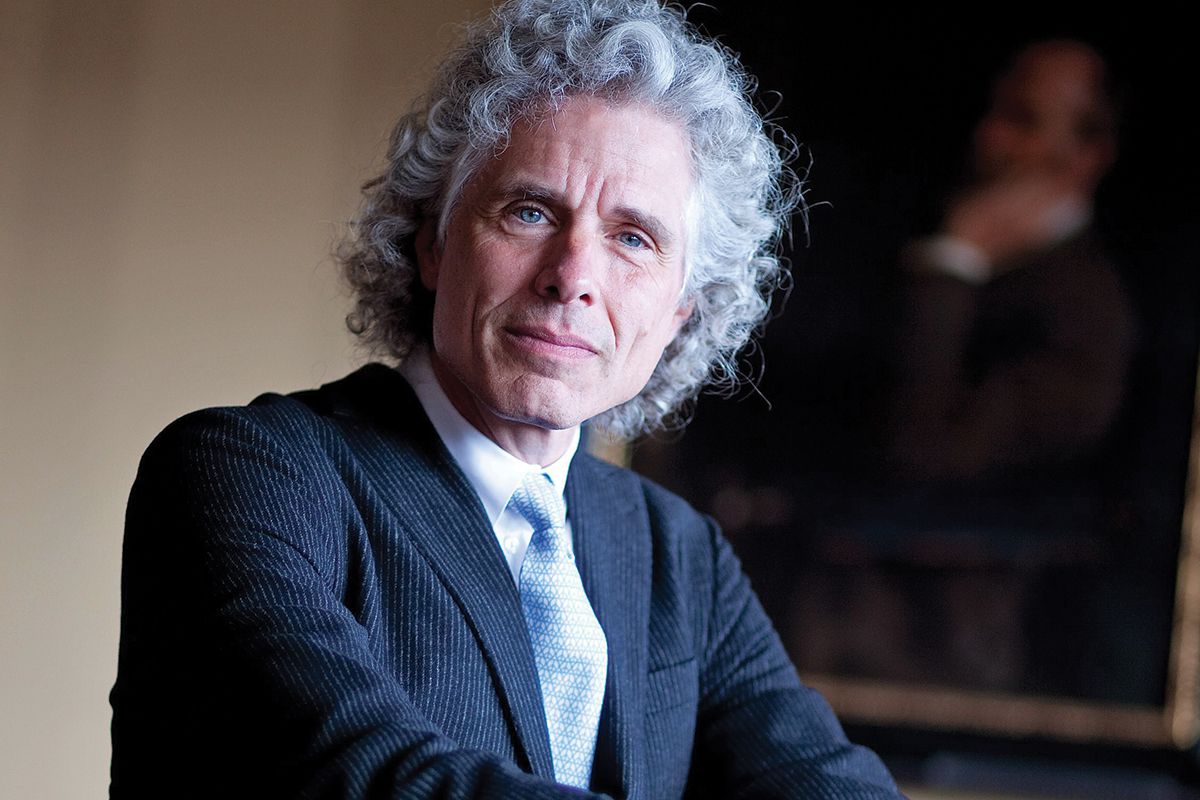
Steven Pinker is an experimental psychologist who conducts research in visual cognition, psycholinguistics, and social relations. He grew up in Montreal and earned his BA from McGill and his PhD from Harvard. Currently Johnstone Professor of Psychology at Harvard, he has also taught at Stanford and MIT.
Additional Resources:
This Book on Amazon:
Enlightenment Now, by Steven Pinker