

This Book is For:
*Ambitious entrepreneurs who are willing to do whatever it takes to scale their companies, regardless of the discomfort, fear of missing out, and hard choices that come from asking the necessary questions.
*People who want to raise their standards, both personally and professionally, and who are willing to commit to following through on the key decisions that elite performers are habitually required to make.
*Anyone who is interested in learning how to use time as a tool for building the future they want for themselves, and for designing the kind of intentional, meaningful life that's always worth living.
Summary:
“Once you raise your floor and eliminate anything and everything that contradicts the level of performance and results you want, your growth will explode.”
-Dr. Benjamin Hardy, The Science of Scaling
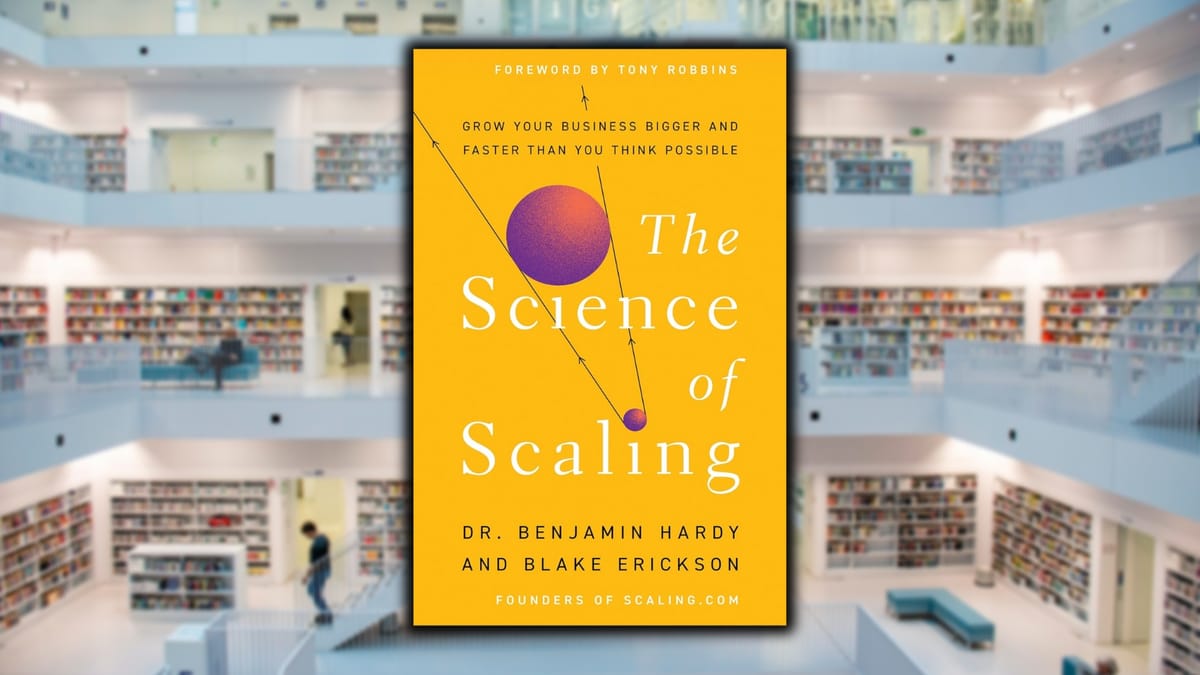
This is easily one of the most transformative business books that I’ve ever read, and it’s also extremely simple to understand and explain.
It’s short, deadly effective, and the “profits per page” that business owners can expect to generate from The Science of Scaling is insane. After reading it, you'll feel like you’ve scaled yourself up as a person as well.
The main idea here is that for rapid growth (as in the exponential, “how is this even legal?” kind of growth), almost nothing will work. Almost everything is also a waste of time. For high, hard goals, there are only a very limited number of pathways that will take you there.
One of the biggest mistakes that business owners make is “optimizing something that shouldn’t exist,” or attempting to grow things inside their business that will never take them where they want to go.
For example, if you have multiple offers, lines, or products, and the one that’s the most time-consuming to deliver only brings in 15% of your total profits, you must get rid of it in favor of re-allocating your limited resources toward developing your core offer that is able to scale to multiple seven figures.
The starting point of business strategy is setting the proper goal, and The Science of Scaling will help you set the type of seemingly-impossible goals that force focus, and demand that you become who you have to be in order to make it happen.
In order to do that, you have to raise your floor, or the minimum standards for what you’re willing to accept. In your business, your life…everywhere. In exactly the same way that the majority of things you could do won’t take you to where you want to go, the majority of your thoughts are detrimental to your progress as well.
That’s one of the core realizations I came to myself while reading the book. Raising your floor also means raising the quality of the thoughts you think, which requires you to level-up your social circle, the daily issues and events you care about, the books you read…everything.
Companies that apply Dr. Hardy’s scaling framework routinely grow between 10-100X within just three years, but the majority of business owners aren’t ready to scale; structurally or psychologically. They’re not willing to do what it takes.
Most business owners are simply not ready to make the hard decisions about what kind of business they want to build, what kind of sacrifices they’re prepared to make, what kind of partners they want to surround themselves with, and how fast they’re willing to move.
Perhaps the most powerful idea in the book on an individual level though, (and not purely from a business standpoint) concerns using time as a tool. Your past and future both direct and shape what you do in the present, but the future is much more effective than the past in guiding the decisions that will impact your success, to say nothing of your happiness.
You can learn from the mistakes of your past and commit to never repeating them again (and that’s great), but only a clear and compelling vision of your future can lead to rapid business growth and personal development.
In my own business, I’ve used the ideas from Benjamin Hardy’s book to radically simplify everything that I’m doing. I’m now more focused and in control than ever before, and the goals that I’ve set are now powerful filters for deciding what I should and shouldn’t be spending my extremely valuable time on.
After reading The Science of Scaling, my business makes more sense (and more money) than ever before. Not only that, but I’m now absolutely convinced that when you raise your floor, your minimum standards, there’s no success ceiling that will ever permanently limit your life.

Key Ideas:
#1: The Case for Seemingly-Impossible Goals
“When you have a goal that’s so big it seems impossible, and a deadline so short it seems absurd, you are forced to:
1) More accurately and honestly filter everything you’re currently doing, being left to acknowledge that the majority is a distraction based on sunk cost bias or lack of accountability, and 2) More powerfully filter for the most innovative and teleporting pathways (and partners) you otherwise couldn’t see or find.
When you commit yourself to a seemingly impossible goal - in both scale and timeline - you quickly see that almost everything in your current business (and possibly your life) is ‘optimizing things that should not exist.’”
Arnold Schwarzenegger once said that shooting for the smaller goal automatically puts the larger goal out of reach. People fail at achieving large goals all the time, but not reaching for them in the first place guarantees your mediocrity.
What happens when you set a seemingly-impossible goal with a seemingly-absurd deadline is that you automatically increase the expected value of your success. Put simply, aiming for a 100X increase in revenue over the next three years means that even if you "only" achieve a 50X increase in five years, you're way ahead of where you would have been, had your initial goal been something boring (and relatively easy) like a 25% increase in that same timeframe.
What's more, you'll also start to see that virtually everything you're now doing is a waste of time. I'll have more to say about this later on, but setting seemingly-impossible goals is also an exercise in extreme simplicity. Your task list will shrink by an order of magnitude, you'll question your default assumptions and uncover new opportunities for rapid growth, and you'll start seeing pathways to victory that were literally invisible to you before you set that massive goal.
This is nothing less than a total revolution in your thinking and your way of operating. You'll be on track to achieve exponential growth, while your competitors are still mired in complexity and corporate bureaucracy, and even your "failure" will be more profitable to you than their highest conception of success.
#2: Almost Nothing Will Work
“From the reference frame of an almost impossible goal, almost nothing will work. Therefore, such a goal serves as a razor-sharp filter for your current situation and decisions.”
One major factor in your success is the vehicle you use to get there. To take an extreme example, to become a billionaire in the next ten years, there's almost nothing you can do to make that happen. Almost nothing.
Putting aside the fact that becoming a billionaire may not even be a worthwhile goal for you (very possible), if that were your goal, that automatically limits the available pathways to getting there. Day trading isn't going to do it, becoming a tax accountant won't get you there, and starting a hot dog stand in NYC gives you an approximately 0% chance of making it.
No, to become a billionaire, just take a look at how most billionaires made their money: founding and scaling a company, investing and asset management, inheritance (that's a big one!), and things like that. For that seemingly-impossible goal (and others), almost nothing will work.
For myself, I have much more "modest" goals for my business. I just want to get to $50,000 per month in revenue. A lifestyle business. That's it. It's not "nothing," and it's certainly a lot more money than most people make, but it's also a lot smaller than the goals of many readers of Dr. Hardy's book. And that's okay.
I once added up virtually everything I could possibly want out of life, and what it would cost me per month to make it all happen, and I came up with about $30,000 per month. Increasing it to $50,000 takes care of taxes, additional investments, a cash buffer, etc. I'm also happy now, but that's a discussion for another time.
What I'll say now though, is that with respect to the revenue streams I have operating in my business, only a few of them could take me to $50,000 per month.
Running ads in my newsletter, landing sponsors for my YouTube channel, and attracting members to my Skool community could make up a large chunk of that (or even the whole thing eventually), with the other revenue streams basically on the back burner.
For example, I sell my book notes from the 1,000+ books that I've read on my Patreon for $1/month, but I'd need 50,000 people to join if that was my only revenue stream! Whereas, with sponsorships, just four sponsors at $5,000 each adds up to $20,000 per month right there.
All of this is to say that it's incredibly freeing to realize that you don't have to do so many things at the same time! You don't have to start six companies, or try and do drop-shipping, and a YouTube channel, and drive for Uber, and and and...
In fact, trying to run some Frankenstein business like that is only going to hold you back! You can't just keep adding things all the time. No, you need to subtract, and you have to take an honest look at all the things that won't take you where you want to go. Then, you need to be emotionless about eliminating them.
#3: Massive Goals Are Decision Filters
“Goals enable you to filter your experience in the present and make decisions. Consequently, the goals you set have enormous implications not only in how you operate in the present, but also in the direction and results you create.
If you set the wrong goal, you’ll be unable to filter the signal from the noise. Your life and business will either stagnate and stall due to complexity or you’ll scale in entirely the wrong direction.
For attainable goals, the perceptual filter is too dull to separate the signal from the noise. With such goals, you can’t filter and find the most powerful pathways forward among the near-countless options you could pursue.
Frankly, attainable and linear goals justify you in maintaining not only your existing system and process, but also your existing assumptions and beliefs.”
Goals and time are both incredible decision filters. Meaning, you can use them to evaluate the choices and pathways you have in front of you, helping you to make the best decision going forward. Time I'll talk about later, but let's start with goals.
People with no goals struggle to make decisions, because they have no idea what's even important or what's worth focusing on. And people with small goals often make decisions that limit their possibilities for success in the future.
Setting the right goal literally determines your potential, and it also changes what you see. Not only that, but is also shows you what you can safely ignore. If your goal is to 100X your revenue in the next three years, you're probably going to want to (politely) reject the offer from your friend from high school asking you to help him manage his corner coffee shop. Unless it's going to be the next Starbucks, managing that shop is likely going to be nothing more than a distraction. It might even be a somewhat profitable distraction! But it's all time that could have been spent closing deals and expanding your main business.
When you really think about it, all success really comes down to is a series of decisions. You're here, right now, and at the end of 10,000 or 50,000 or 500,000 decisions is the massive success you're looking for.
The problem is that there are only so many decisions you can make, and every time you choose to make a decision that takes you closer to achieving some smaller, relatively unimportant goal is a decision that could have been taking you to that outrageous success that you really want. Instead of taking five steps in a hundred different directions, commit to taking five hundred steps in one direction and see how far you get.
#4: Your Goals Determine What You See
“Your frame or perspective determines what you see and is based on your goals. It determines what is relevant and irrelevant. Small or linear goals are an ineffective filter, keeping you stuck in complexity and noise.”
Your reticular activation system is the tool your brain uses to filter your reality.
What you look for determines what you see, and once your "tell" your RAS to start looking for ways to achieve a particular goal, your brain goes to work delivering that reality to you by bringing you opportunities and uncovering pathways to make it happen. It's not magic, it's not mysticism, it's just a function of how the human mind works. Which is actually pretty magical when you think about it!
In actual practice, this means that once you've consciously decided that something is important to you, it'll start appearing more often in your field of awareness. The most common example most people cite is when you're looking at buying a new car, you start seeing that specific type of car everywhere.
The reality is that it was always there, but until your brain was tuned to look for Porsche Boxsters or Ford Mustangs, they got filtered out because you weren't paying attention. The same goes for literally any other goal you could select.
In the context of business, when you start thinking in terms of seemingly-impossible goals and exponential growth, you'll start seeing new opportunities everywhere you look. They were always there, mind you, but you didn't see them because you weren't "ready" for them.
Small goals keep you fixated on all the minor things you could do to make an extra $100 here or there, or increase profits by 15%, etc. But when you select massive goals, you signal to your brain that it's time to look for ways to make them happen.
#5: Noise Doesn't Scale
“You can’t scale a complex system. You can’t scale noise. You can’t scale if you’re too afraid to define yourself and commit.”
Simple scales, complexity fails. Businesses that have too many different moving parts and things to keep track of can quickly spiral out of control and become a nightmare to manage, much less grow.
If you have fifty different things that you're tracking, working on, etc., and there are dozens of ways they could each go wrong, that's going to be a much more difficult business to grow than one where you have, say, three revenue streams, three growth channels, and one ideal customer profile.
An even simpler business would be one where you publish YouTube videos (growth channel), for HR managers who want to achieve a better work/life balance (customer profile), with a link in your video descriptions where they can book a call with you and potentially hire you as a coach (revenue stream).
That's sooo much simpler (yet potentially much more profitable, all things considered) than posting on five different platforms, trying to reach people who want to be healthier (such a broad category that it becomes meaningless), selling everything from courses to coffee mugs.
The first person is going to find it much easier to enroll five people in their coaching program for $1,000 each, than if they were to dilute their message in a vain attempt to reach "everybody," confusing them with all these different offers and products that try to address a barely-defined need.
This is especially important when/if you reach a stage where you want to hire additional employees. Instead of trying to manage three sales teams, seven video editors, two social media managers, etc., you have just a few moving parts to explain to others, and a very small number of defined pathways to success.
#6: You MUST Raise Your Floor
“When you raise your frame or goal to a seemingly impossible level, almost everything becomes irrelevant, falling below the floor. There are very few, often only one, viable pathways to an impossible goal.
Consequently, these types of goals are highly strategic and enable you to filter out dead ends that distract others and to filter for the most potent paths you otherwise couldn’t find.
Until you face the truth and raise your floor, you’re lying to yourself and are caught in the noise. Once you raise your floor and eliminate what shouldn’t exist, rapid scaling occurs. The floor defines what you don’t do.”
Personal standards are everything in life. They affect your success in so many ways, and this is no less true in the field of business.
Raising your floor, or your minimum standards for what you're willing to accept and do, enables an entire world of possibilities that are simply unavailable to people who are willing to settle for less.
Remember: almost nothing will work. If your goal is to raise $50M in venture capital funding, starting a Patreon probably isn't going to be the best decision. Likewise, if your seemingly-impossible goal is to make it to the Olympics, you shouldn't attempt to become a world-class violinist at the same time.
That's to say nothing of the more mundane choices we make every single day. When you have a seemingly-impossible goal, you can't go out drinking five nights a week, hang out with toxic people all day, catch every episode of "that new show," whatever it is. Those activities are all beneath your floor, and you have to eliminate them if you're truly serious about success.
There's a mental component at work here too, where the thoughts you think are either above or below your floor as well. That was one of my biggest realizations while reading The Science of Scaling. Perhaps 90% of the thoughts you think aren't conducive to getting where you want to go in life. Thoughts of regret, revenge, petty annoyances, the various injustices (real or perceived) we each experience throughout the day - none of these things are above your new floor. Drop them.
#7: The Goal Determines the Pathway
“Pathways thinking is a person’s ability to find or create multiple pathways to a goal. The better a person gets at pathways thinking, the faster their progress. The first step of pathways thinking, or strategy, is realizing that the goal you set determines the pathways you’ll take.”
This is a mental exercise worth doing (and recommended in the Action Steps section below), and it involves mentally walking down several different potential pathways that get you to your goal, and then selecting the best one.
For a business owner who wants to reach $10,000 in monthly revenue, there are multiple ways to get there, not all of which are created equal. Some will take too long, some will be too uncertain, some will be unethical or immoral...there are many "wrong" paths where a person could get lost on their way to $10K/month.
It's a worthwhile exercise, however, because it expands your mind, opens up your options, and makes it more likely that you discover a pathway to your goal that will work. What Dr. Hardy's saying above is that the bigger your goal, the fewer available pathways there will be to reach it. The goal determines the path.
#8: The 3 Things That Shape What You See and Do
“The quality and clarity of your goal, as well as your commitment to it, shapes both what you see and the actions you take.”
Taking what we said about the RAS even further, the quality and clarity of your goal matters as well, along with the strength of your commitment. Selecting a good goal in the first place is the first step, but seeing its every contour and detail, visualizing it intensely, is the next step after that. Thirdly, you have to keep advancing confidently towards it, no matter what, for however long it takes.
We've already spoken at length about selecting high-quality goals (and there's more to come below), but the clarity with which you can observe that successful realization of that goal in your mind is consistently underrated as well.
Think about every single Olympic athlete you've ever seen or heard about. The fighter pilots, the ultra-successful entrepreneurs - they all saw their idealized, desired future in their minds, almost exactly as if it were a present reality. That's the kind of detail you need to develop and return to in your mind.
Then, you have to commit. But not in the "well, I'll give it my best shot" kind of way, but as though your life depends on it. At the very least, your future depends on it, which is your life. Or at least your potential life if you select the proper goal, see it as though it were already achieved, and never let it go.
#9: Cultivate Ruthless Self-Honesty
“For a goal to be an effective tool, it must be an intense filter. The goal must force you to be far more rigorous and honest with yourself about everything you’re currently doing.”
Most people are lying to themselves, pretty much every single minute of every single day. The Reality Principle, as Robert Ringer calls it, is a tough one to consistently apply, as it's so much easier and more comfortable to live in a state of blissful self-delusion...until the future actually gets here, and you realize that you could have had everything you've ever wanted, had you not been so unserious.
Cultivating ruthless self-honesty is about building an accurate map of reality, and basing your decisions on how the world actually is, instead of how you would like the world to be. What's true won't always feel good, but if you actually care about scaling, it won't matter. You're in this no matter what, remember?
#10: The Feedback Loop That Forces Results
“An important factor to realizing goals is known as readiness to change.
Put simply, until a person is ready, they stall and avoid needed learning and work. They distract themselves and justify a lack of progress. They celebrate effort over results.
A key factor to increase one’s readiness is a heightened awareness of the consequences for changing or not changing.
The reality of time and its consequences is the most potent lever for readiness. Deadlines, although uncomfortable, force readiness. They force you to face the brutal facts. They force you to stop putting your energy in noise and distractions. Deadlines are a feedback loop that forces results.”
A maniacal sense of urgency, and a disposition towards radical action are two characteristics that consistently lead to success. You have to want it, you have to get serious about it, and you have move move move. Now. All the time. At least if you're serious about making massive changes.
Most people simply aren't ready to scale - in business or otherwise - and you know what? That's totally fine. You don't have to want what everyone else wants, and you likely won't, if you're being honest with yourself. Again, the important thing is simply never to lie to yourself.
What helps to develop a maniacal sense of urgency is a heightened awareness of the consequences of not changing, of not doing something different, of not moving fast. Again, if you can mentally scale up the pathways and try to catch a glimpse of your future if nothing changes, you can become inspired to make radical changes in the here and now.
When it comes to scaling a company, you'll want to set aggressive deadlines, and you'll want to make clear the consequences for not hitting them. When you know that something terrible is going to happen if you don't hit these deadlines (even if it's "only" public embarrassment), it really gets you moving!
#11: Time is a Tool
“Psychologically, time is a tool for making decisions. Rather than separating the past, present, and future, as we typically do, I explained to them that how they frame their own past and future directly shapes their present decisions and actions.”
Your past is a tool to improve your present, but your future is a power tool to improve your present. Both can help you make better decisions in the here and now, but looking ahead to the future will give you better direction and more useful information than staying stuck in the past.
Learning from the mistakes and negative experiences of your past can tell you what not to do in the future, but they can't really help you set a new direction. Sure, you can kinda sorta figure out what you want to get away from, but it's only by looking ahead to the future that can you set a course to an exciting, meaningful, and profitable new reality.
Using time as a tool means using your future, desired reality as a filter for what you do in the here and now. Knowing where you want to end up in the future determines the moves and actions you take in the present, and this kind of clarity can help you make more correct decisions, because you'll know exactly where you're headed. As they say, if you don't know where you're going any road will take you there.

Book Notes:
“You never change things by fighting the existing reality. To change something, build a new model that makes the existing model obsolete.”
-Buckminster Fuller
“What man actually needs is not a tensionless state, but rather the striving and struggling for a worthwhile goal, a freely chosen task.”
-Viktor Frankl
“Breakthroughs are not born from certainty - they’re born from unreasonable goals, urgent timelines, and emotionally compelling reasons why.
Here’s what most people never understand: The key to exponential growth isn’t having the perfect plan. It’s having a massive, seemingly impossible target - one that forces you to think, operate, and execute differently.”
-Tony Robbins
“Set a goal that redefines the game, create powerful emotional reasons that pull you through inevitable challenges, and set a deadline that doesn’t give you the luxury of procrastination.”
-Tony Robbins
“A goal properly set is halfway reached.”
-John Doerr
“The most common mistake of a smart engineer is to optimize a thing that should not exist.”
-Elon Musk
“Rarely is a business not only focusing on what matters and what can scale but also systematically weeding out all that ‘should not exist,’ which can never scale.”
“The hefty price for accepting information uncritically is that we go through life unaware that what we’ve accepted as impossible may in fact be quite possible.”
-Dr. Ellen Langer
“To effectively scale, you build a simple system focused on the highest signal. You cannot scale a complex and contradicting system. Most people and most companies are unwilling to choose a focused path.”
“The goal shapes the process. When you change the goal, you change the process. Making your goal massive - even seemingly impossible - forces you to find a much better path, including more effective partners.”
“You can expect the future to take a definite form, or you can treat it as hazily uncertain. If you treat the future as something definite, it makes sense to understand it in advance and to work to shape it.
But if you expect an indefinite future ruled by randomness, you’ll give up on trying to master it. Indefinite attitudes to the future explain what’s most dysfunctional in our world today. Process trumps substance: when people lack concrete plans to carry out, they use formal rules to assemble a portfolio of various options.”
-Peter Thiel
“We can spend weeks, months, even years laboring, trying to change our attitudes and behaviors and not even begin to approach the phenomenon of change that occurs spontaneously when we see things differently.”
-Stephen R. Covey
“The goal determines the process - what is signal and what is noise. The more effective you are at framing your future, the more powerful your process will be in the present.”
“The McKinsey study found the same thing Elon’s Five-Step Algorithm teaches: after you’ve simplified your focus, you’ve got to accelerate like crazy. Fast-feedback loops are where rapid growth happens, and without rapid growth, you’re stagnant and stalling.”
“The future is better viewed as a psychological and strategic tool, rather than a concrete reality. The purpose of the future is to impact, shape, and direct the present.”
“When it comes to running a company, if you give yourself too much time to do something, you can’t filter the present hard enough. The purpose of the impossible goal and deadline is that the filter becomes extremely intense! If you only have 18 months to do what you thought you had 10 to 15 years to accomplish, you can’t waste your time on nonsense.”
“When you apply time as a tool and give yourself far less time than you think you need, you’re forced to find the crux or core bottleneck or constraint to solve much more quickly. By identifying and solving the crux from the beginning, rather than the many false constraints that are noise, you’ll scale radically faster. Few are willing to choose a focused and optimized path.”
“If you want to be exceptional, you can’t engage in average anything.”
“If I could simplify the whole game of power and strategy in one equation, it would all hinge on the capacity to see events around you exactly as they are. The closer your mind is to reality, the better your strategies, your responses in life.”
-Robert Greene
“I have long believed that if a student of virtually any discipline could avoid ever repeating the same mistake twice - both technical and psychological - he or she would skyrocket to the top of their field.”
-Josh Waitzkin
“Raising the floor is the crux of scaling. It’s the hardest part, and until you do it, you’re fooling yourself. But once you do it, your growth literally explodes.”
“In order to scale a system, you’ve got to simplify it.”
“Having conflicting goals, dedicating resources to unconnected targets, and accommodating incompatible interests are the luxuries of the rich and powerful, but they make for bad strategy. Strategy is at least as much about what an organization does not do as it is about what it does.”
-Dr. Richard Rumelt
“The difference between successful people and really successful people is that really successful people say no to almost everything.”
-Warren Buffett
“The primary value and purpose of a goal is its impact on your direction and decisions today. The future is a tool to simplify the present.”
“In an age of infinite leverage, judgement is the most important skill.”
-Naval Ravikant
“The first natural advantage of good strategy arises because other organizations often don’t have one. And because they don’t expect you to have one either.”
-Dr. Richard Rumelt
“You first have to be world class yourself. Tens don’t work for eights.”
“Human beings are works in progress that mistakenly think they’re finished.”
-Dr. Daniel Gilbert
“By the time a student gets to college, he’s spent a decade curating a bewilderingly diverse resume to prepare for a completely unknowable future. Come what may, he’s ready - for nothing in particular.”
-Peter Thiel
“All three dimensions of time - past, present, and future - co-occur in the now. No one dimension of time can truly be a meaningful dimension without the context provided by the other two dimensions.”
-Dr. Brent Slife
“The quality of how we frame our future determines the quality by which we can filter our present experience.
Given that our goals are the primary aspect of our frame, driving our attention and decisions in the present, it makes sense that the quality of our goals determines the quality of our selective attention, or filtering.
This is why impossible goals and impossible deadlines are so powerful. They force extreme filtering in the present, requiring you to let go of all ineffective pathways and select only the most powerful and potent ones.”

Important Insights from Related Books:
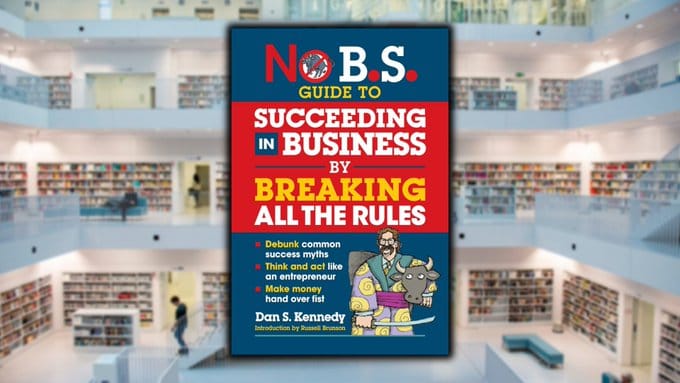
No B.S. Guide to Succeeding in Business by Breaking All the Rules, by Dan S. Kennedy:
There's always a way to succeed in life, no matter who you are or where you come from, but you're never going to find it by following the herd. If the herd knew how to achieve success and get everything they ever wanted, you wouldn't need this book.
Sample Quotes from the Book:
“Give up forced ‘positive thinking’ or ‘motivation’; instead, build a solid foundation of strong self-image, well-defined goals, practical plans, and know-how that naturally produce positive expectancy, initiative, and follow-through. Cultivate REASONED optimism. Have something tangible to believe in and to be excited about - not just excitement itself.”
“In fact, some excellent career or business advice is to pick endeavors because of the type of person the endeavors will force you to become.
An early mentor used to urge people of very limited financial means to commit to the goal of becoming a millionaire, not so much for the money, he explained, but because of the people they would have to become, the positive characteristics and behaviors they would have to develop in order to achieve the financial benchmark.
He was widely misunderstood on this point and perceived by some to be a preacher of greed. What he meant, simply, was:
Big commitment to big goals build big people.”
“College graduates, on average, out-earn non-college graduates by six figures to, at most, a million dollars, lifetime. That IS an argument in favor of a college education, although a million dollars divided over 40 to 60 years of active work is not as gigantic as it sounds stated as a lump sum.
Look closer and here is what you will discover: If college actually prepares you for anything, it is for a job. College does not prepare you to be entrepreneurial, and it certainly does not prepare you to get rich.”
Read the Full Breakdown: No B.S. Guide to Succeeding in Business by Breaking All the Rules, by Dan S. Kennedy
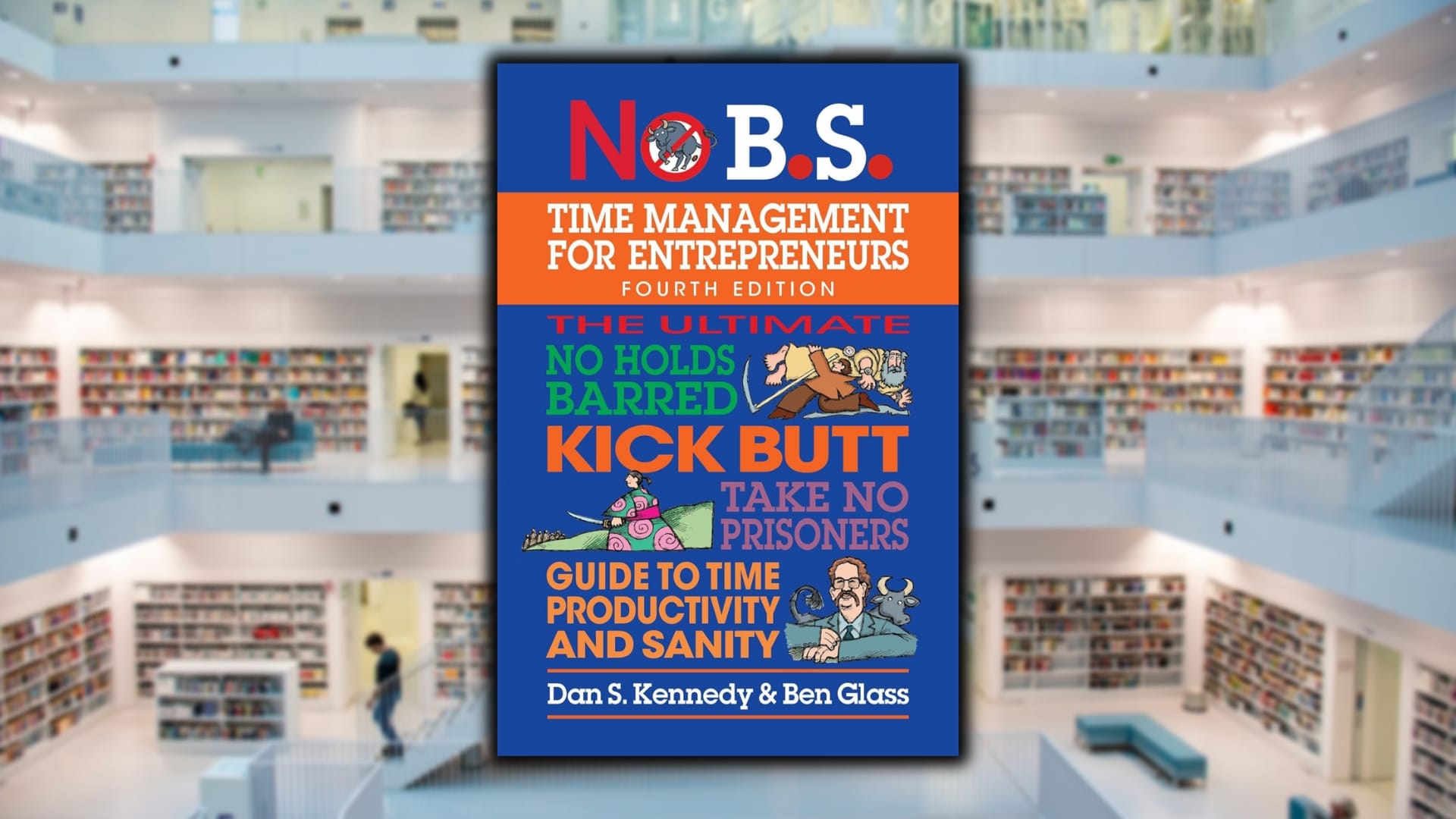
No B.S. Time Management for Entrepreneurs, by Dan S. Kennedy:
In this book, the eccentric entrepreneur Dan S. Kennedy shares the extreme time management strategies he uses personally to run his multimillion-dollar company, all while successfully safeguarding his schedule and his sanity.
Sample Quotes from the Book:
“There’s a reason why you can’t find a wall clock in a casino to save your life - those folks stealing your money do not want you to be aware of the passing of time.
And that tells you something useful right there: you want to be very aware, all the time, of the passing of time. It is to your advantage to be very conscious of the passage and usage of minutes and hours.”
“Just as the person who cannot tell you where his money goes is forever destined to be poor, the person who cannot tell you where his time goes is forever destined to be unproductive - and, often, poor.”
“This tells you a lot about what you must do in order to achieve maximum success, derive maximum value from your time, and lead the happiest possible life:
You must systematically, aggressively divest yourself of those activities you do not do well and do not do happily, or you must find routine, so as to systematically invest your time (and talent, knowledge, know-how, and other resources) in those things you do extraordinarily well, enjoy doing, and find intellectually stimulating.
I have just described for you a formula for peak personal productivity, as a specialist. And you ought to note that, in every field of enterprise, specialists out-earn generalists ten to one.”
Read the Full Breakdown: No B.S. Time Management for Entrepreneurs, by Dan S. Kennedy
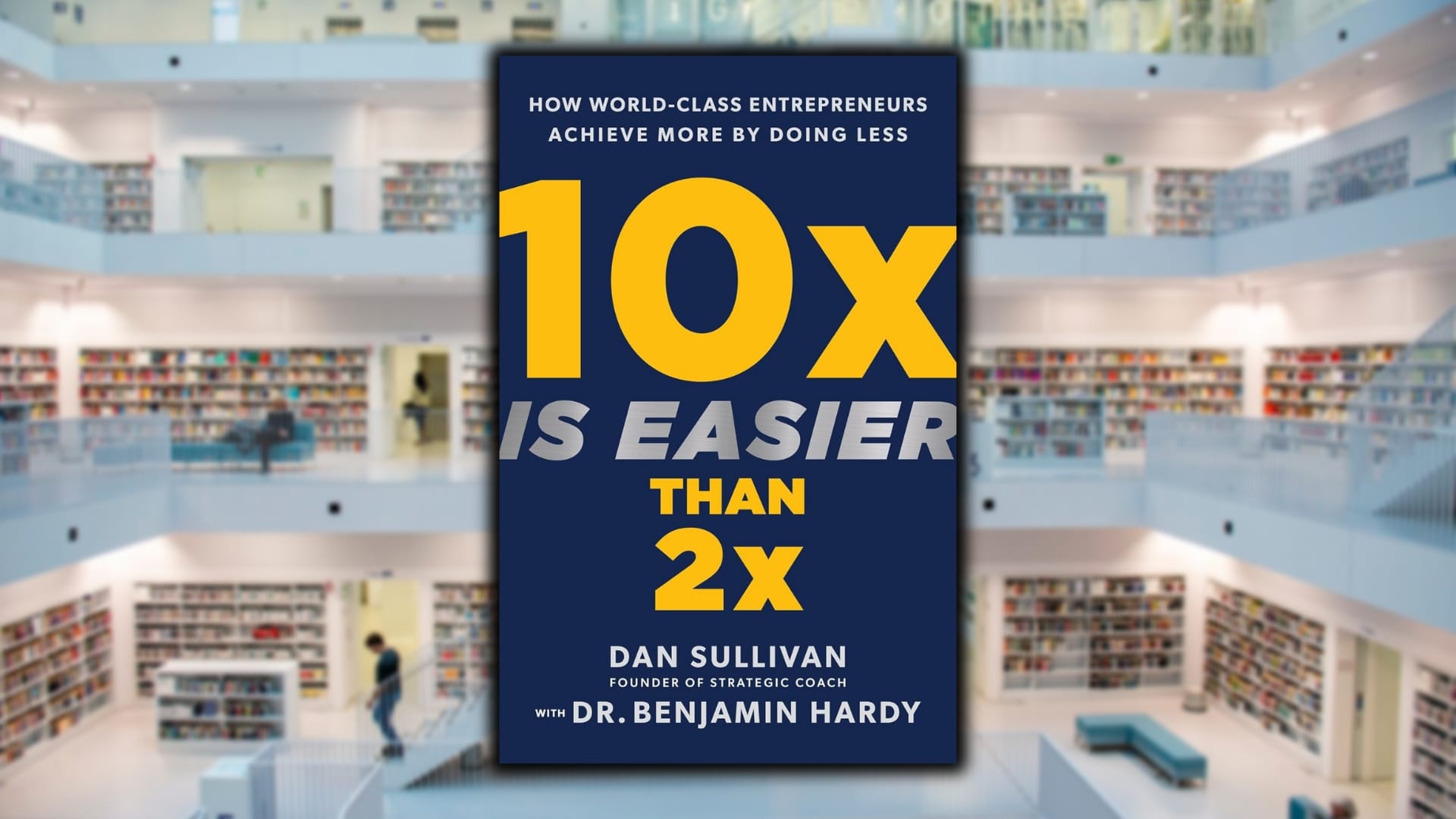
10X Is Easier Than 2X, by Dr. Benjamin Hardy:
Almost everything you're doing now is a distraction preventing you from making a 10X leap - in revenue, leadership ability, significance, and more. Exponential transformations are actually easier than these small little 2X improvements, and Dr. Benjamin Hardy will prove it to you here in this book.
Sample Quotes from the Book:
“Going 10x means you’re living based on the most intrinsic and exciting future you can imagine. That 10x future becomes your filter for everything you do, and most of your current life can’t make it through that 10x filter.”
“In all aspects of life, the competition is highest for average goals. Not only is the competition highest, but the excitement is lowest and the pathway forward is dramatically more complex and confusing with small and linear goals.
With unrealistic, impossible, or ‘10x’-level goals, the competition is lowest, the excitement is highest, and the pathway forward becomes simple and nonlinear. You stop following the crowd. You shift toward quality rather than quantity and stop competing with anyone.”
“To make a goal effective, you’ve got to test its outer-limits. Push it out as far as you can. Only once you make your goal impossible will you stop operating based on your current assumptions and knowledge.”
Read the Full Breakdown: 10X Is Easier Than 2X, by Dr. Benjamin Hardy

Questions to Stimulate Your Thinking:
The quality of your questions determines the quality of your life. That's also how you get the absolute most out of any book that you decide to read:
You ask great questions the whole time - as though the book was on trial for its life.
Here in this section are a few questions that can help guide and stimulate your thinking, but try to come up with your own additional questions, especially if you decide to read this book the whole way through...
“What is the goal shaping everything you’re now doing?”
“Do you have multiple competing goals, or one singular purpose driving everything you’re doing?”
“What is the biggest and most important goal you have in your business? What if you gave yourself half the time to achieve it? How would that change your process and focus? What would you be required to eliminate?”
“Take all the pathways and pursuits you’re currently focusing on and mentally scale each of them up to their highest potential. When you do that, does each pathway actually give you what you want?”
“What are you currently saying yes to? Whatever you say yes to reflects your actual floor, not the required floor of your goal.”
“What if the floor for a much higher future actually became your floor? What if you stopped saying yes to stuff that has unbelievable opportunity cost?”
"Judge a man by his questions, rather than by his answers."
-Voltaire

Action Steps:
So you've finished reading. What do you do now?
Reading for pleasure is great, and I wholeheartedly support it. However, I am intensely practical when I'm reading for a particular purpose. I want a result. I want to take what I've learned and apply it to my one and only life to make it better!
Because that's really what the Great Books all say. They all say: "You must change your life!" So here, below, are some suggestions for how you can apply the wisdom found in this breakdown to improve your actual life.
Please commit to taking massive action on this immediately! Acting on what you've learned here today will also help you solidify it in your long-term memory. So there's a double benefit! Let's begin...
#1: Set a Seemingly-Impossible Goal
Whatever you're thinking, double it. Or triple it. Hell, 100X it for all I care. Just think bigger. The goal you select should challenge you (obviously), and it shouldn't be immediately obvious whether or not you can pull it off.
As you gain more experience in goal-setting, you'll learn your true limits, but you'll also stretch those limits by consistently setting larger goals than you think you can handle. Don't invest money you can't afford to lose, but also don't set some boring target of attracting 10 customers in the next 150 days. Try 150 customers in 10 days. That's more like it!
#2: Set a Seemingly-Impossible Time Limit
The other part of the equation involves dramatically shortening your time horizon. If adding $100,000 in profits to your company is something you feel like you can achieve in the next year, try to do it in 30 days. It's a qualitatively different goal, and the person you'll become by trying to reach it is not the same person you'd become if you had settled for $100K over the next year.
#3: Mentally Scale Up Each Pathway
When you've selected your seemingly-impossible goal, and zeroed in on a seemingly-impossible time limit, evaluate your options for how you'll get there. If your company sells a $50 product, a $500 product, and a $10,000 product, and your goal is a $100,000 increase in revenue, visualize what it would take to get there if you could only do it by focusing on one product.
For example, maybe you could partner with 100 influencers to help you sell the $50 product, at a commission rate of 50%. With those terms, you'd need to sell 4,000 of them to reach $100,000 in revenue (I'm simplifying a ton, obviously), or 40 per influencer, on average. What about partnering with a larger influencer and giving them a higher or lower percentage? Or a flat fee? Or what about running Facebook ads instead? There are sooo many ways to sell a $50 product online - or offline! Consider offline, too!
For the $10,000 product, how many sales calls would it take (assuming you know your numbers here, which you should!) to close 10 extra deals? Who do you know that can introduce you to more prospects? Do you even need sales calls? Think through each path and select the best one, according to your preferences, likelihood of success, and other factors.
#4: List Everything You're Currently Doing
As we've discussed, virtually everything you're doing now is not taking you to your goal - at least not in the most efficient way possible. Sure, updating the testimonials on your website is important, but what if you just 1,000X'd the traffic to your landing page instead? Would the increased conversion percent make up for whatever sales the outdated testimonials are costing you? There are tons of examples like this.
Realistically, only a very few things you're currently doing are absolutely necessary for you to hit your seemingly-impossible goal. In this step though, I just want you to list them all out so you know what they are. Most business owners have no idea.
#5: Delete 90% of What You're Currently Doing
You heard me. Delete almost everything, and only if you notice after the fact that it was completely necessary do you add it back in. If you're currently updating your landing pages, switching to a new email service provider, changing your website URL, posting on six different platforms, doing cold outreach through DMs, cold outreach through email, getting on sales calls, appearing on podcasts, recording YouTube videos, etc., etc., etc...stop it! It's completely unnecessary. And in fact, it's holding you back from scaling exponentially. Drop. Nearly. Everything.
#6: Raise Your Floor
Everything you've just cut is now below your floor, and belongs on your "Stop Doing List." Which is exactly what it sounds like: a list of everything you've chosen not to do. You're not posting on TikTok, you're not running Google ads, you're not selling sixteen different products - you're doing this.
Raising your floor impacts the rest of your life too, as we've discussed. So drop friends and relatives who don't support your dreams or who are otherwise holding you back, shift your thoughts (as much as possible) to success-oriented, positive, uplifting ones that are taking you where you want to go, and resolve to eliminate any other bad habits that are negatively impacting your chances of success. You know what they are, so eliminate them.
#7: Enlist Accountability Partners
As they say, the quality of your future depends on the books you read and the people you surround yourself with, so you need to gather a group of like-minded, supportive individuals around you who want to see you succeed, and who would be proud to help you get there. Might I not-so-subtly suggest joining my private business mastermind?
#8: Make an Iron Promise to Your Future Self
This is the big one. One of the most important pieces of advice that I can give you is that you must never, ever, ever - under any circumstances - lie to yourself or willfully deceive yourself in any way. You must be ruthlessly honest with yourself, and you must tell yourself the truth about your world at all times.
When you do that, you'll come to find that a promise to yourself actually means something. It's an unbreakable bond, something that you refuse to walk back on, no matter what. You have to be able to trust yourself and believe in yourself. So the next time you find yourself facing a mirror, look deep into your own eyes and say (internally or out loud): "I promise to do whatever it takes. I will give this everything I have within me, and I will NOT let you down."
"The path to success is to take massive, determined action."
-Tony Robbins


About the Author:
Dr. Benjamin Hardy is an organizational psychologist and author of Willpower Doesn’t Work and Personality Isn’t Permanent, along with many others.
His blogs have been read by more than 100 million people and are featured in the Harvard Business Review, The New York Times, Forbes, Fortune, CNBC, and others. For several years, he was the #1 most-read writer on Medium.com. He and his wife, Lauren, are the parents of six kids. They live in Orlando, Florida.
Additional Resources:
Scaling.com | 10X Your Company in 3 Years or Less
This Book on Amazon:
The Science of Scaling, by Dr. Benjamin Hardy
If You Liked This Book:
10X Is Easier Than 2X, by Dr. Benjamin Hardy
Be Your Future Self Now, by Dr. Benjamin Hardy
Who Not How, by Dan Sullivan and Dr. Benjamin Hardy
Your Next Five Moves, by Patrick Bet-David
The Four-Hour Workweek, by Tim Ferriss