
Summary:
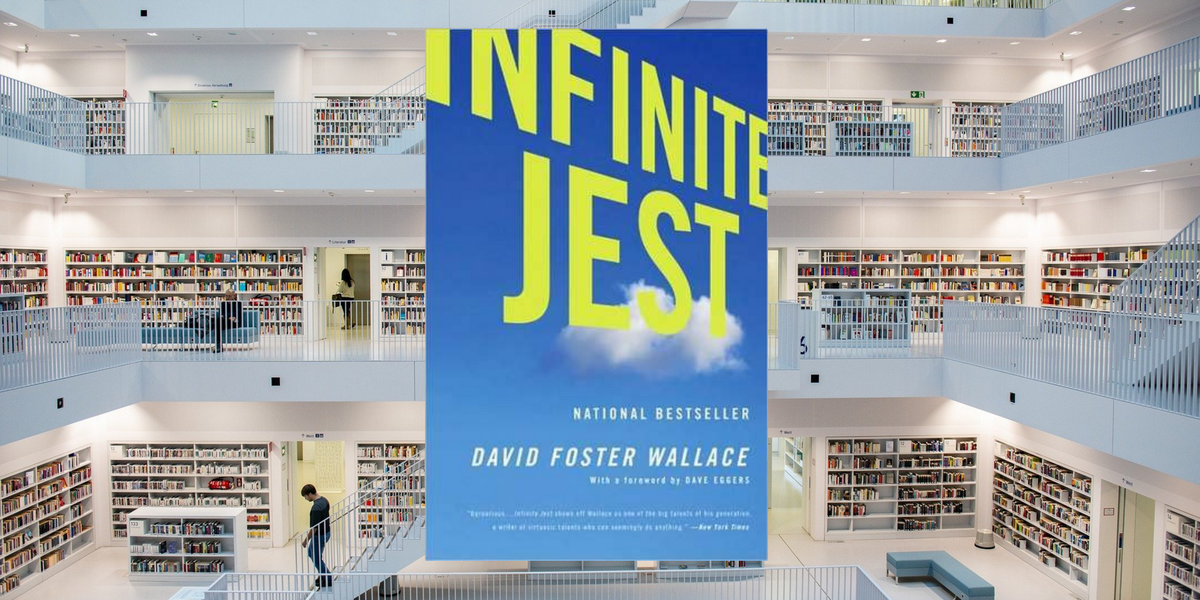
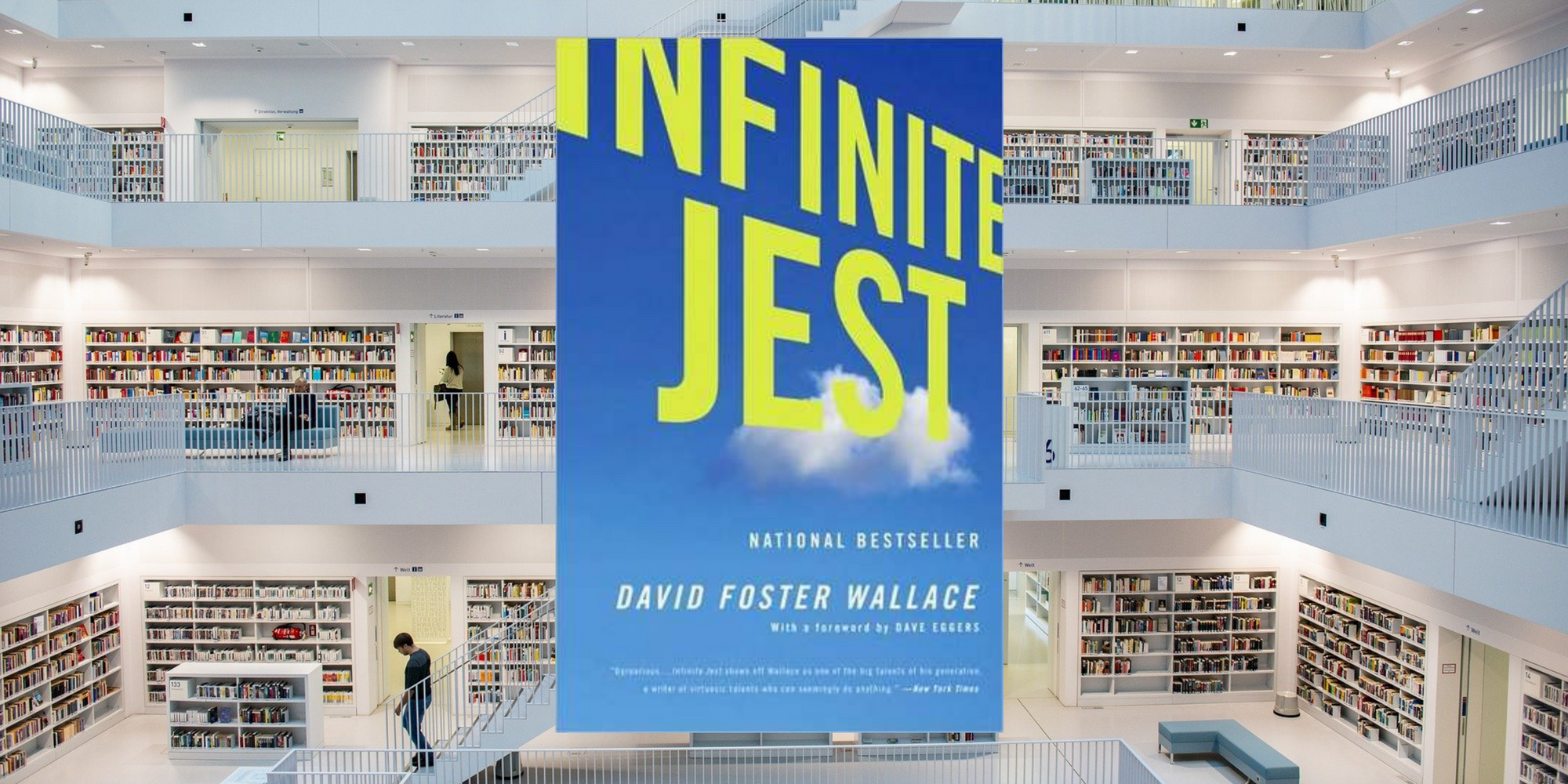
Let me tell you a little bit about what makes Infinite Jest so intimidating, and then I’ll tell you why the epic challenge is so indescribably worth it.
For one thing, it’s over 1,100 pages long, including hundreds of endnotes, which you probably should read because some of them contain crucial plot points and several of the funniest jokes. Wallace uses 20,584 unique words in the 577,608-word book, which ended up sending me to the dictionary on almost every single page. One guy actually calculated this, and he worked out that the first 35,000 words of the novel contain 4,923 unique words, “more than most rappers but still less than the Wu-Tang Clan.”
So it’s long and you won’t know what all the words mean. But what is it actually about?
That’s a big question, but generally, it’s about entertainment, drugs, addiction, suicide, depression, recovery, and um...tennis I guess? Most of the book takes place at an elite junior tennis academy situated next to a halfway house in Boston, USA.
It’s difficult to summarize, but in the near future, all the years have been “sponsored” by corporations, so most of the novel takes place in the Year of the Depend Adult Undergarment, and instead of 2007 or 2008 you’ve got the Year of the Trial-Sized Dove Bar, etc. Where the title Infinite Jest comes from (aside from it being a reference to Hamlet, more on that later) is that the previous director of the tennis academy, a film auteur by the name of James Incandenza has created a “video cartridge” that’s so irresistibly entertaining that anyone who watches it loses all motivation to do anything else other than watch it - Infinite Jest - over and over again until they eventually die.
So there’s one major theme - the addictive nature of entertainment - and the desire of human beings to give themselves away to something, even if that thing destroys them, either psychologically or physically, or both.
Oh yea, and there’s this Canadian-Quebecois separatist group/terrorist cell that wants to steal the master copy of Infinite Jest so that they can deploy it as a weapon in a massive terrorist strike against the American people. The group is made up entirely of guys in wheelchairs, and they’re called Les Assassins des Fauteuils Rollents, or the “Wheelchair Assassins.” In the book, these guys are major badasses, and if, before suffering a brutally violent death, you “hear the squeak,” it’s already too late.
James Incandenza has killed himself before the novel begins (as David Foster Wallace would eventually do himself in 2008), but his wife Avril Incandenza now runs the tennis academy, where their son Hal is a senior.
For literature nerds, this is where you’ll begin to feel all warm and tingly: Hal is based on Hamlet, Avril represents Queen Gertrude, who is then courted by their Uncle Tavis, who in turn represents Uncle Claudius in the play. And of course, James Incandenza comes back as a ghost in the book, just like Hamlet’s father.
“Alas, poor Yorick! I knew him, Horatio, a fellow of infinite jest, of most excellent fancy.”
As if that weren’t enough, Hal is the middle child with two brothers, Orin (the oldest) and Mario (the youngest). Orin, Hal, and Mario each represent Dmitri, Ivan, and Alyosha Karamazov respectively in Dostoyevsky’s The Brothers Karamazov.
But even if you don’t think you’ll get all the references right away (I probably didn’t), don’t let it stop you from reading the book! Infinite Jest has so much heart. It’s just...it’s earnest. It’s really about what it’s like to be a human being in this crazy world, where so much can be stacked against us, and where we have to find the internal resources to survive without destroying ourselves.
It’s simultaneously one of the saddest, funniest books that I’ve ever read in my entire life, and now it’s part of me forever. If you’ve actually finished the book, that’s a big accomplishment, and you should be very, very proud! I’m not saying that “everyone needs to read this,” but here we have a book where the author put every last thing he had within himself to create the absolute greatest work of art that he could, the apotheosis of what he was able to achieve at the time, and I was just - there’s no other word for it - completely blown away pretty much the entire time I was reading it.
One last surprise for the math nerds among us (not me, alas) is that, although it’s not a linear narrative (the story doesn’t go from beginning to end, but rather dodges around), the internal structure of Infinite Jest was meant to resemble a Sierpinski Gasket. I know, What’s that? Well, it’s a fractal structure created when you recursively subdivide (I had to look up “recursively") an equilateral triangle into ever smaller equilateral triangles ad infinitum - so that three triangles fit into the main triangle with their vertices at the midpoints of its side, and in turn, they subdivide into three more triangles, and so on. Yea, I know. What the actual fuck.
All that being said, there’s no reason to be intimidated! You can tackle Infinite Jest! It could take you months, you might want to give up in the middle, and you might wanna throw the book out the window (or “defenestrate” it, as Wallace might say), but David Foster Wallace always recognized, and said repeatedly, that the writer’s primary obligation is to the reader. Wallace is adamantly anti-pretentiousness, anti-irony, anti-everything-that-insults-the-reader.
As he said, "It's a weird book. It doesn't move the way normal books do. It's got a whole bunch of characters. I think it makes at least an in-good-faith attempt to be fun and riveting enough on a page-by-page level so I don't feel like I'm hitting the reader with a mallet, you know, 'Hey, here's this really hard impossibly smart thing. Fuck you. See if you can read it.' I know books like that and they piss me off."
I don’t want this book summary to have to come with its own endnotes, so I’ll leave it there. But this is a very, very special book, and David Foster Wallace was a brilliant writer. I hope you enjoy this book as much as I did.

Key Ideas:
#1: Entertainment, and consumption in general, can never fill the hole inside ourselves where our real selves should be. One of the sorts of “earnest ironies,” if you will, of Infinite Jest is that, although entertainment can serve as an escape from the anxiety of recognizing one’s mortality or lack of meaning and connection, entertainment itself can be fatal psychologically. It can numb us into thinking that being entertained all the time is the goal of a good life.
#2: No single moment is unendurable. The parts of the book taking place at the halfway house are just unbelievable to anyone who’s never struggled with addiction or meaninglessness.
David Foster Wallace didn’t take his own advice, tragically, but he understood when he wrote Infinite Jest that, even when you think you can’t go on, you actually can. You can survive one more moment, and the next, and the next. You can survive anything, moment by moment, until you string enough moments together to pull yourself out of the abyss.
#3: “The truth will set you free. But not until it is finished with you.”
#4: “Sometimes human beings have to just sit in one place and, like, hurt.”
#5: “You will become way less concerned with what other people think of you when you realize how seldom they do.”
#6: “There is such a thing as raw, unalloyed, agendaless kindness.”
#7: “99% of the head’s thinking activity consists of trying to scare the ever-living shit out of itself.”
#8: “That there might not be angels, but there are people who might as well be angels."

Book Notes:
“But the SOUNDS he made."
"Indescribable."
"Like an animal."
"SUB-animalistic noises and sounds."
"Nor let's not forget the GESTURES."
"Have you ever gotten HELP for this boy Dr. Tavis?"
"Like some sort of animal with something in its mouth."
"This boy is damaged."
"Like a stick of butter being hit with a mallet."
"A writhing animal with a knife in its eye."
"Sounded most of all like a drowning goat. A goat, drowning in something viscous."
“The integrity of my sleep has been forever compromised, sir.”
“I’m so scared of dying without ever being really SEEN.”
The object of the game is to send from yourself what you hope will never return.
“And Lo, for the Earth was empty of form, and void. And darkness was all over the Face of the Deep. And we said: Look at that fucker DANCE."
“Sometimes human beings have to just sit in one place and, like, hurt.”
“You will become way less concerned with what other people think of you when you realize how seldom they do.”
“There is such a thing as raw, unalloyed, agendaless kindness.”
“99% of the head’s thinking activity consists of trying to scare the everliving shit out of itself.”
“That there might not be angels, but there are people who might as well be angels."
“I mean literally LOST his mind, like the massive dose picked his mind up and carried it off somewhere and put it down someplace and forgot where."
"I think we get the picture, Mike."
“Entertainment is blind.”
“Boy, you really put the small 'r' in romance, don’t you.”
"The way a White Flagger formulates this, e.g., is that 99.9% of what goes on in one's life is actually none of one's business, with the .1% under one's control consisting mostly of the option to accept or deny one's inevitable powerlessness over the other 99.9%, which just trying to parse this out makes Don Gately's forehead turn purple."
“Almost nothing important that ever happens to you happens because you engineer it. Destiny has no beeper; destiny always leans trenchcoated out of an alley with some sort of Psst that you usually can't even hear because you're in such a rush to or from something important you've tried to engineer."
“Time began to take on new aspects for him, now, as Withdrawal progressed. Time began to pass with sharp edges. Its passage in the dark or dim-lit stall was like time being carried by a procession of ants, a gleaming red martial column of those militaristic red Southern-U.S. ants that build hideous tall boiling hills; and each vile gleaming ant wanted a miniscule little portion of Poor Tony's flesh in compensation as it helped bear time slowly forward down the corridor of true Withdrawal.
By the second week in the stall time itself seemed the corridor, lightless at either end. After more time time then ceased to move or be moved or be move-throughable and assumed a shape above and apart, a huge, musty-feathered, orange-eyed wingless fowl hunched incontinent atop the stall, with a kind of watchful but deeply uncaring personality that didn't seem keen on Poor Tony Krause as a person at all, or to wish him well. Not one little bit. It spoke to him from atop the stall, the same things, over and over. They were unrepeatable.
Nothing in even Poor Tony's grim life-experience prepared him for the experience of time with a shape and an odor, squatting; and the worsening physical symptoms were a spree at Bonwit's compared to time's black assurances that the symptoms were merely hints, signposts pointing up at a larger, far more dire set of Withdrawal phenomena that hung just overhead by a string that unraveled steadily with the passage of time. It would not keep still and would not end; it changed shape and smell. It moved in and out of him like the very most feared prison-shower assailant.
Poor Tony had once had the hubris to fancy he'd had occasion really to shiver, ever, before. But he had never truly really shivered until time's cadences - jagged and cold and smelling oddly of deodorant - entered his body via several openings - cold the way only damp cold is cold - the phrase he'd had the gall to have imagined he understood was the phrase chilled to the bone - shard-studded columns of chill entering to fill his bones with ground glass, and he could hear his joints' glassy crunch with every slightest shift of hunched position, time ambient and in the air and entering and exiting at will, coldly; and the pain of his breath against his teeth."
“How is there freedom to choose if one does not learn how to choose?”
“Marathe had made gentle fun of the inoriginality of a journalistic cover, then later less gentle fun of Steeply's cover's false name, expressing humored doubts that the meaty electrolysized face of Steeply would be responsible of launching even one ship or vessel."
“The truth will set you free. But not until it is finished with you.”
“You burn with hunger for food that does not exist.”
“The key to the successful administration of a top-level junior tennis academy lies in cultivating a kind of reverse-Buddhism, a State of Total Worry."
“The left side of his face feels like something that means him harm and is coming gradually closer.”
“Certain drills are well known to be nothing more than attitude-adjusters, designed to do nothing but dramatically lower life-quality for a few minutes. Too brutal to be assigned on the daily basis that would contribute to genuine aerobic conditioning, drills like the disciplinary version of Tap & Whack are known to the kids simply as Pukers. Puker-drills are really meant to do nothing but hurt you and make you think long and hard before repeating whatever you did to merit them; but they're still to all outward appearances exempt from any kind of VIII-Amendment protest or sniveling calls home to parents, insidiously, since they can be described to parents and police alike as just drills assigned for your overall cardiovascular benefit, with all the actual sadism completely sub rosa."
“Like many gifted bureaucrats, Hal's mother's adoptive brother Charles Tavis is physically small in a way that seems less endocrine than perspectival. His smallness resembles the smallness of something that's farther away from you than it wants to be, plus is receding."
“She went around with her feelings out in front of her with an arm around the feelings’ windpipe and a Glock 9mm. to the feelings’ temple like a terrorist with a hostage, daring you to shoot.”
“Lenz enjoys a sympathetic and listening ear to have around; he has numerous aspects and experiences to mull over and issues to organize and mull, and (like many people hardwired for organic stimulants) talking is sort of Lenz's way of thinking. And but most of the ears of the other residents at Ennet House are not only unsympathetic but are attached to great gaping flapping oral mouths which keep horning into the conversation with the mouth's own opinions and issues and aspects - most of the residents are the worst listeners Lenz has ever seen."
“At lunchtime, Hal Incandenza was lying on his bunk in bright sunlight through the window with his hands laced over his chest, and Jim Troeltsch poked his head in and asked Hal what he was doing, and Hal told him photosynthesizing and then didn't say anything else until Troeltsch went away. Then, 41 breaths later, Michael Pemulis stuck his head in where Troeltsch's had been.
'Did you eat yet?'
Hal made his stomach bulge up and patted it, still looking at the ceiling.
'The beast has killed and gorged and now lies in the shade of the Baobob tree.'
'Gotcha.'
'Surveying his local pride.'
'I gotcha.'
Over 200 breaths later, John ('N.R.') Wayne opened up the ajar door a little more and put his whole head in and stayed like that, with just his head in. He didn't say anything and Hal didn't say anything, and they stayed like that for a while, and then Wayne's head smoothly withdrew."
“He lives for applause from exactly two hands.”
“He does not overwhelm with brightness, it is true.”
“A region of the South End so blasted and dangerous no cabbie with anything to live for will even go there.”
“He’s going to take a personal interest in their discomfort.”
“Stice, oblivious, bites into his sandwich like it’s the wrist of an assailant.”
“Her chatter is listener-interest-independent.”
“He keeps imagining the little hyphen of wrinkle Poutrincourt gets between her eyebrows when she doesn't follow something and can't quite tell if it's your English's fault or her English's fault."
“He made no secret of the fact that he had balls of unrejectable steel where horrifyingly pretty girls were concerned.”
"She'd sleep with anything with a Y chromosome."
One of the main themes of Infinite Jest - and itself a great irony - is that although entertainment can serve as an escape from the anxiety of recognizing one's mortality, entertainment itself can be fatal psychologically.
"The so-called 'psychotically depressed person' who tries to kill herself doesn't do so out of quote 'hopelessness' or any abstract conviction that life's assets and debits do not square. And surely not because death seems suddenly appealing. The person in whom Its invisible agony reaches a certain unendurable level will kill herself the same way a trapped person will eventually jump from the window of a burning high-rise. Make no mistake about people who leap from burning windows. Their terror of falling from a great height is still just as great as it would be for you or me standing speculatively at the same window just checking out the view; i.e. the fear of falling remains a constant. The variable here is the other terror, the fire's flames: when the flames get close enough, falling to death becomes the slightly less terrible of two terrors. It's not desiring the fall; it's terror of the flames. And yet nobody down on the sidewalk, looking up and yelling 'Don't!' and 'Hang on!', can understand the jump. Not really. You'd have to have personally been trapped and felt flames to really understand a terror way beyond falling."
“Hal had never actually seen projectile-weeping before.”
“Like all the world’s light had gotten together and arranged itself into the shape of a face. Or something.”
“No single instant of it was unendurable. Here was a second right here: he endured it. What was undealable-with was the thought of all the instants all lined up and stretching ahead, glittering.”
“Everything unendurable was in the head, was the head not Abiding in the Present but hopping the wall and doing a recon and then returning with unendurable news you then somehow believed."
“It now lately sometimes seemed like a kind of black miracle to me that people could actually care deeply about a subject or pursuit, and could go on caring this way for years on end. Could dedicate their entire lives to it. It seemed admirable and at the same time pathetic. We are all dying to give our lives away to something, maybe."
“The parts of this Gately can follow he doesn’t care for one bit. He doesn’t want to know his body even fucking has something with six syllables in it.”
“If colors themselves could catch fire.”

Action Steps:
So you've finished reading the book. What do you do now?
#1: Go without a form of entertainment that you love for one week.
The Roman statesman Seneca used to go months at a time where he would sleep on the floor, eat the most uninspiring foods imaginable, and go without any form of luxury whatsoever. The purpose was to inure himself to poverty, even though he was one of the richest people in the entire empire.
You never want to get to a place where you need something, be it television, drugs, or coffee. So pick something that you love to do or have, that you normally do or consume every day, and give it up for a set period of time, say a week or a month.
#2: Become someone’s sponsor or accountability partner.
A good portion of the book deals with AA (Alcoholics Anonymous) and its various derivatives. Programs like these can be exceptionally helpful in combating addiction (obviously), and if you can sponsor someone else and help them maintain sobriety, you can help change that person’s life.
If AA’s not really your thing, just offer to be an accountability partner for someone, and help make sure they stick to whatever goal they’ve set for themselves. I have several accountability partners and I can testify as to their effectiveness.
#3: Appreciate sobriety.
If you’re not addicted to anything, consider how huge of a blessing that is. Just take a moment and appreciate how much freedom you have over yourself! No price is too high for the privilege of owning yourself, and if you’ve been able to do this, despite living in a world where someone or some company is always pushing something onto you, you should be proud of accomplishing something that’s in fact exceptionally difficult.
About the Author:
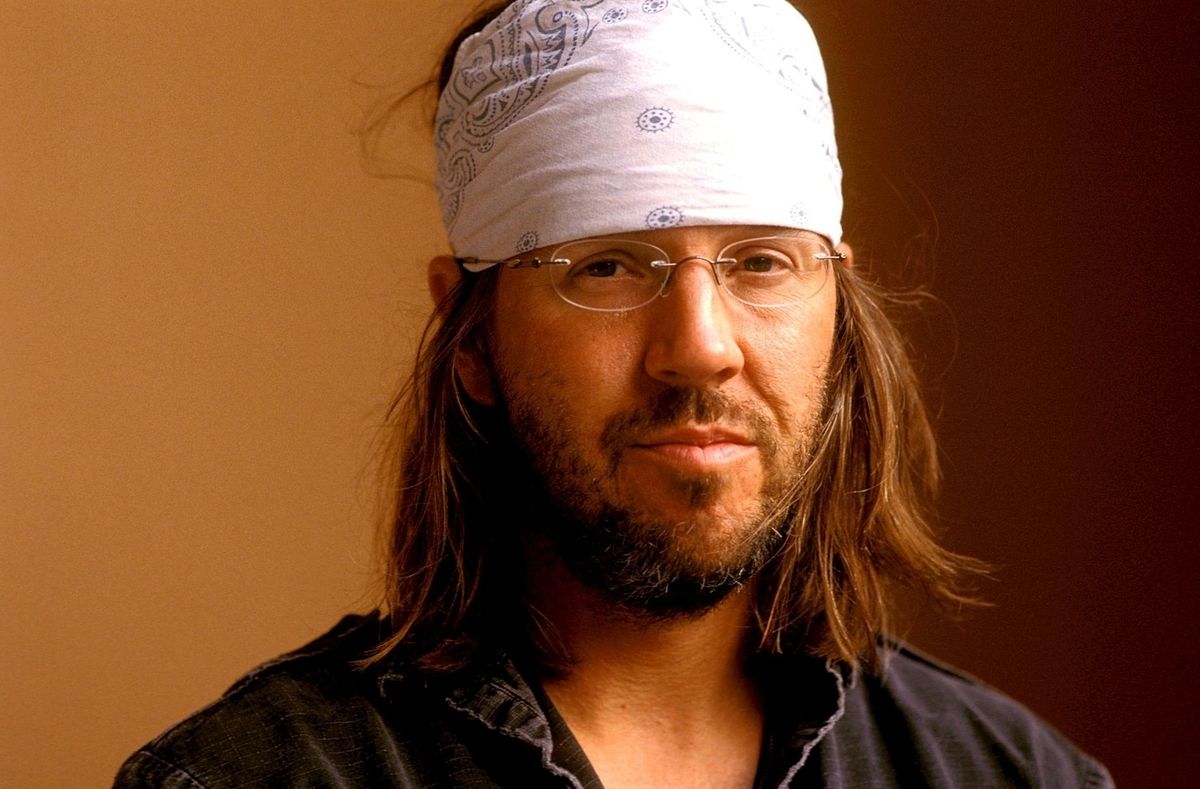
David Foster Wallace was an American author of novels, short stories and essays, as well as a university professor of English and creative writing. Wallace is widely known for his 1996 novel Infinite Jest, which Time magazine cited as one of the 100 best English-language novels from 1923 to 2005. His posthumous novel, The Pale King, was a finalist for the Pulitzer Prize for Fiction in 2012.
Additional Resources:
Infinite Jest - 20 Things You Need to Know
This Book on Amazon:
Infinite Jest, by David Foster Wallace
If You Liked This Book:
A Supposedly Fun Thing I’ll Never Do Again, by David Foster Wallace
The Corrections, by Jonathan Franzen
Hamlet, by, ya know, Shakespeare