
Summary:
This Book is For:
- Anyone who is concerned about the devastating poverty afflicting America right now and the millions of people facing shelter insecurity.
- People who are concerned about poverty generally and who want to translate the lessons of poverty in America into solutions in their own countries.
- Students of sociology who want to witness an academic giant tackle an intricate, delicate, and expansive research project.
- Anyone who feels diminished by the knowledge that someone, somewhere, faces the prospect of homelessness and societal neglect.
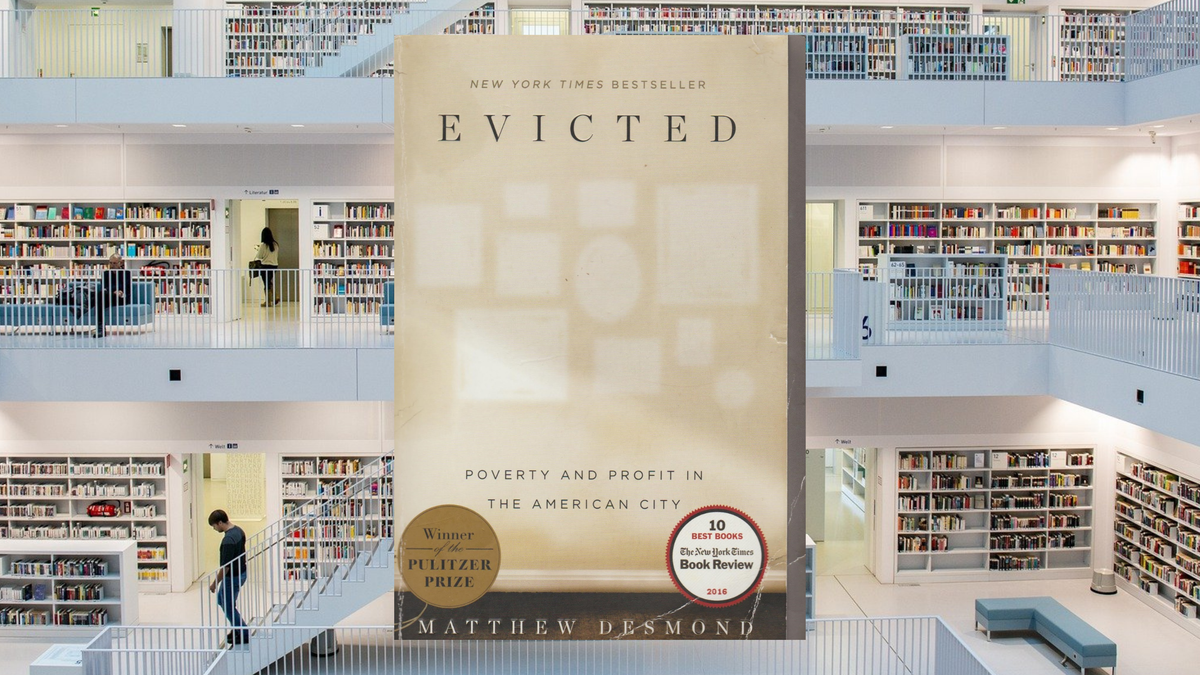
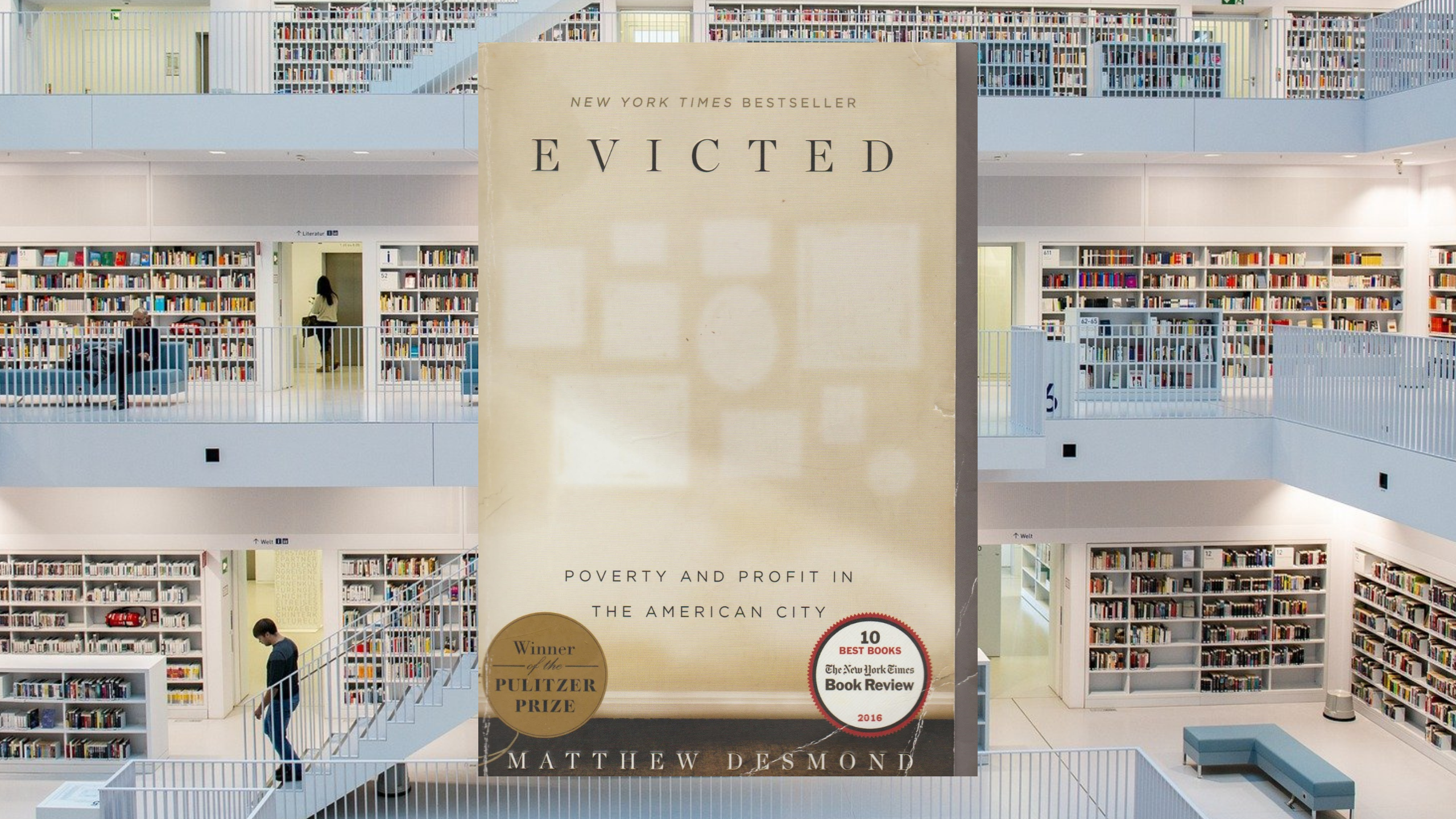
This nonfiction account of the nationwide scourge of homelessness in America has won pretty much every book award that I could name off the top of my head and dozens that I couldn't. To name just a few, it's won The Pulitzer Prize, the National Book Critics Circle Award for Nonfiction, The PEN/John Kenneth Galbraith Award for Nonfiction, The Andrew Carnegie Medal for Excellence in Nonfiction, the Hillman Prize for Book Journalism, and many, many more.
So yes, it's good. In the book, Princeton sociologist Matthew Desmond takes to the field and follows eight families in Milwaukee as they battle the indignities and hardships of being poor in 21st-century America. Economic exploitation is nothing new, but here, Desmond actually leaves the protected enclosure of academia and spends a significant amount of time experiencing first-hand what millions of Americans live with each and every day.
"I moved into a poor trailer park nicknamed 'The Shame of the Southside' by the news media. I lived there for about five months before moving into a rooming house in the middle of the inner city, where I’d live for nine months. Living in those neighborhoods, I met families facing eviction and began spending my days with them. I sat beside families at eviction court, followed them into shelters, slept at their houses, and joined them at births and funerals."
-Matthew Desmond
The basic problem is that as more and more people move to the cities, land prices and values there go up, making them far too expensive to live in. Suddenly, you've got people like Arleen, whom Desmond profiles in the book, whose rent ended up taking 88 percent of her income. In her case, she was forced to decide whether to help pay for her sister's funeral costs or pay the rent for her and her two boys. What becomes clear over the course of the book is that there are "Arleens" everywhere, all over the country, in every American city.
Desmond came to recognize that eviction is a cause, not just a condition, of poverty in America. There's a downward spiral associated with evictions that can cause these problems to become even more acute. Many landlords won't rent to recently evicted families, and being evicted even makes it harder to apply for public housing. It can cause people to lose their jobs - which means they can't pay rent, which continues the cycle. All that, of course, says nothing about the psychological tolls exacted because of all of this.
As Desmond says:
"Then there is the toll eviction takes on a person’s spirit. The violence of displacement can drive people to depression and, in extreme cases, even suicide. One study I published found that two years after their eviction, mothers still reported higher rates of depression than their peers.
When you add all this up, the evidence is overwhelming. The lack of affordable housing - the gap between the need and the amount of housing aid offered, and the resulting common occurrence of eviction in struggling communities - these are main causes of poverty in America. We can’t fix poverty without fixing housing."
Much of this book is depressing and unbelievably sad. That much is obvious. But what is also clear is that, even in the darkest corners of America's housing crisis, poverty has not completely prevailed against the deep humanity of the people whom Desmond came to know and trust.
In the worst, most depressing situations, people can still laugh, can still come through for one another, and can still keep moving forward. America has also made impressive strides over the years when it comes to housing. The work is nowhere near complete, but good people everywhere have begun.
The basic premise of Evicted is that without stable shelter, everything else falls apart. This kind of stability is a fundamental human right, denied to far too many for far too long. Universal housing programs have been successfully implemented all over the developed world, and there's no reason to think it can't work in America too. The alternative? As Desmond says:
"This degree of inequality, this withdrawal of opportunity, this cold denial of basic needs, this endorsement of pointless suffering - by no American value is this situation justified. No moral code or ethical principle, no piece of scripture or holy teaching, can be summoned to defend what we have allowed our country to become."

Key Ideas:
#1: Evictions Are Big Business
“These days, there are sheriff squads whose full-time job is to carry out eviction and foreclosure orders. There are moving companies specializing in evictions, their crews working all day, every weekday."
There's a lot of money to be made off the poor, and Matthew Desmond writes that even if we haven't thought about it in that way, it's a fact that many landlords have never forgotten.
Of course, not all landlords are out to squeeze every penny of profits out of their tenants, with no thought or regard to their health or well-being. Owning, investing, and renting out real estate is a legitimate way to make a living, and people in all careers and professions are capable of exhibiting generosity and compassion - and/or behaving in despicable ways.
The major idea here, though, is that there is money to be made off human misery as well, and there are people out there who can and do stoop to that level. One of the greatest things about Evicted is that Desmond shows that light and darkness coexist within the same professions, same communities, and even within the same people.
#2: The Math Doesn't Work
“In Milwaukee, renters with housing vouchers were charged an average of $55 more each month, compared to unassisted renters who lived in similar apartments in similar neighborhoods. Overcharging voucher holders cost taxpayers an additional $3.6 million each year in Milwaukee alone - the equivalent of supplying 588 more needy families with housing assistance."
Here's just one of many examples where clear failures of common sense and legislation are failing the American public, and with cruel, disastrous results. What's happening here is basically that people receiving housing vouchers are being overcharged in rent, which is basically negating the positive effects of being issued the vouchers in the first place.
In effect, the government could pay for 588 more needy families to find homes and end up saving money, instead of issuing vouchers to people whom landlords will eventually just overcharge. It's not that the housing vouchers are the problem - it's that they are being taken advantage of by seedy landlords.
This kind of bad math and tragic logic shows up everywhere when you look at poverty numbers. There's no "easy fix," of course, but emergency room visits for homeless people cost the governments tens of thousands of dollars per person, more than it would cost them to just pay for that person's housing. And according to some estimates, there are 33 empty properties for each homeless person in the US. It's almost like no one in government owns a calculator.
#3: Nasty, Brutish, and Short
“Humans act brutally under brutal conditions.”
In 1651, Thomas Hobbes wrote in his book, Leviathan, that without the civilizing effects of good government, human life would be "nasty, brutish, and short." As true today as it was then, the main idea here is that without stability, without firm foundations - without a home - human beings often act brutally towards one another.
Personal responsibility is profoundly important, and blaming "the system" is never the whole answer, but any well-informed view of the nature and causes of poverty has to take into account the environment within which individuals live, work, and struggle. Environment matters, and so it's no surprise that in exceptionally threatening and uncertain environments people just aren't good to one another.
There's no "system" that is the best and most wonderful and that will work perfectly in all situations, but the prevailing system does profoundly affect the psychological conditions of any and all individuals living within that system. When people are just holding on to a basic level of survival, then violence, conflict, and substance abuse is what you will see.
Extremely important to understand here is how brutal conditions limit the scope and range of one's thinking and hinder long-term planning and progress. When the future is so uncertain, and everything looks so dark, then it makes perfect sense, in the cruel logic of poverty, to steal and hurt and wreck.
An individual in that situation isn't even thinking about the higher levels of human development - or transcendence - they are just working on meeting their immediate needs the only way they know how to. If that doesn't make sense to us, it's only because we don't understand that under the same psychological conditions, we would most likely act the same way.
#4: Renters Face Devastating Choices
“If she told someone how damaged she was, and how she coped, would she be allowed to keep her children? This mother didn't know and wasn't going to find out."
In the book, Matthew Desmond describes how people can be evicted for calling the police too many times, even if they have very, very good reasons for doing so. To the individual in question, it could be a matter of life and death, or at least extreme physical or psychological harm, yet to the landlords, it's just a "disturbance" that's threatening their ability to rent out apartments to "decent" people.
This leads to many renters being faced with a brutal choice: it's either call the police and risk getting evicted, or don't call the police, and potentially suffer horrific domestic violence and abuse, while failing to call for help.
Most people in secure homes just don't face these types of choices. They aren't ensnared in the catch-22 of, "I need to call the police in order to ensure my own safety, but if I call the police, I'll be evicted and be kicked out into the streets, where my safety will be greatly endangered."
Evicted is full of these types of stories - America is full of these types of stories - and they are happening everywhere across the country, and throughout the world. The sound-bites are real. They each represent real struggle, real danger, and real loss of human dignity and stature.
#5: The Only Constant is Change
“Stability and instability: these are not fixed states as much as temporary conditions poor families experience for varying periods of time."
Change, uncertainty, and life-threatening danger are daily realities for the urban poor in America, and it's pretty much the only thing they can rely on. Low-income individuals move through a revolving door of jobs and neighbors and prospects and health conditions and interpersonal relationships that change on a monthly, weekly, and sometimes daily basis.
When things are going well - they have a job, a roof over their head, a supportive community of friends and family - life is good, but in an inherently unstable environment, all of these basic rights and freedoms are constantly under threat. They can change in an instant, as drugs and violence sweep through the neighborhood, predatory lenders exact their monetary revenge, health conditions deteriorate and hospital bills pile up. What was running so much more smoothly last month is now thrown into total disarray.
It's extraordinarily difficult to build any sort of happy, productive, meaningful life for oneself under these sorts of conditions, and yet here they are, doing it (barely) and somehow managing. They may be barely holding on, they may not know what next month (or tomorrow) holds, but today is a good day. Today they ate, went to work, and came home. A home is stability. A home is comfort and life. Without a home, everything else falls apart.
#6 Rental Assistance Programs Save Lives
“Public initiatives that provide low-income families with decent housing they can afford are among the most meaningful and effective anti-poverty programs in America. Not every public housing resident or voucher holder is poor - many are elderly or disabled; others have modest incomes - but every year rental assistance programs life roughly 2.8 million people out of poverty."
#7: Pain and Potential
“A community that saw so clearly its own pain had a difficult time also sensing its potential.”
Everyone needs someone who sees more in them than they see in themselves. For millions of children in America, that person was Mister Rogers. On his children's television show, he would tell kids that he liked them "just the way you are," and he really meant it. But there are untold masses of children - and adults - in America right now who have never heard anyone tell them that they mattered.
Raising one's sights over one's current conditions is so important in facilitating change, and if a person can't see a way out, they likely won't go looking for one. They'll remain stuck in poverty, despair, and misery, and that's exactly what was happening in many of the communities in which Desmond was doing his field work. As he says in the book:
“Living in degrading housing in dangerous neighborhoods sent a clear message about where the wider society thought they belonged.”
In poverty, as in certain propositions in physics, starting conditions matter. They matter a lot. And these virtuous and vicious cycles, once they get going, can be incredibly hard to stop, as many people profiled in the book can attest. The signs of their "unworthiness" and hopelessness were everywhere, but not the potential. That's the tragedy of Evicted, except played out across an entire country, and not just in the life of a solitary individual.
#8: We Just Don't Get It
“People who have never experienced chronic hunger are apt to underestimate its effects.”
-Abraham Maslow
#9: Two Ways to Dehumanize
“There are two ways to dehumanize: the first is to strip people of all virtue; the second is to cleanse them of all sin.
Every single individual contains multitudes. Any particular individual that you encounter is going to be a mix of extremely recognizable human emotions, strengths, failings, and potentialities, but we are conditioned to make huge generalizations.
Rich people are greedy. Rich people are the ones who drive humanity forward. Poor people are lazy. Poor people are humble and virtuous. These endless, interminable generalizations about vast swaths of the population (most of whom we've never even met, I might add) go on and on, whether we're speaking about jobs and careers, or races and genders, and whatever else so foolishly divides us.
As Aleksandr Solzhenitsyn wrote in The Gulag Archipelago, the line between good and evil runs down the middle of every human heart, and so an accurate view of human nature will take into account all the ways we can dehumanize each other by not recognizing our flaws and virtues. Abraham Lincoln also once said that, "I do not like that man. I must get to know him better," and I don't think that's horrible advice.
#10: What Do the Poor Want?
“By and large, the poor do not want some small life. They don't want to game the system or eke out an existence; they want to thrive and contribute."
The simple answer to the question, "What do the poor want?" is this: they want the same kinds of things as the rest of us do. The Roman playwright Terence said that "Nothing human is alien to me," and we can hold this quotation close to us as we consider the human beings we pass by on the street every day and wonder what they're thinking.
Poor people aren't necessarily lazy or vicious or anything else that we can generalize. They don't want to succeed any less than we do, thrive any less than we do, or become anything less than what we aspire to become. As Desmond has consistently shown throughout this entire book, people everywhere are more alike than they are different, and we forget that to the detriment of our own humanity.
Some of the best expressions of this idea come from the work of David Foster Wallace, and I'll quote from another book I've covered here at the Stairway to Wisdom, Although of Course You End Up Becoming Yourself. The book is an extended conversation between Wallace and Rolling Stone contributor David Lipsky as the former was on book tour for Infinite Jest. Wallace says:
“I just think to look across the room and automatically assume that somebody else is less aware than me, or that somehow their interior life is less rich, and complicated, and acutely perceived than mind, makes me not as good a writer. Because that means I'm going to be performing for a faceless audience, instead of trying to have a conversation with a person."
Book Notes:
“Her face had that look. The movers and the deputies knew it well. It was the look of someone realizing that her family would be homeless in a matter of hours.”
“Lenny grinned and went back to his paperwork until the door swung open again. People who got half an ear everywhere else got a full one from Lenny."
“Especially for jobless men, the indignity of facing your family empty-handed built up to the point where abandonment became the lesser disgrace. To stay in a committed relationship was 'to live with your failure, to be confronted by it day in and day out.'"
“The poor are constantly exposed to evidence of their own irrelevance.”
“Living in degrading housing in dangerous neighborhoods sent a clear message about where the wider society thought they belonged.”
“When we try to understand ourselves, we often begin by considering the kind of home in which we were raised.”
“When people have a place to live, they become better parents, workers, and citizens.”
“Residential stability begets a kind of psychological stability, which allows people to invest in their home and social relationships.”
“But those solutions depend on how we answer a single question: do we believe that the right to a decent home is part of what it means to be an American? The United States was founded on the noble idea that people have 'certain unalienable Rights, that among these are Life, Liberty and the pursuit of Happiness.' Each of these three unalienable rights - so essential to the American character that the founders saw them as God-given - requires a stable home."
“We have overlooked a fact that landlords never have: there is a lot of money to be made off the poor.”
“Most federal housing subsidies benefit families with six-figure incomes. If we are going to spend the bulk of our public dollars on the affluent - at least when it comes to housing - we should own up to that decision and stop repeating the politicians' canard about one of the richest countries on the planet being unable to afford doing more. If poverty persists in America, it is not for lack of resources."
“Poverty has not prevailed against their deep humanity.”
"I am frequently asked how I 'handled' this research, by which people mean: How did seeing this level of poverty and suffering affect you, personally?
I don't think people realize how raw and intimate a question this is. So I've developed several dishonest responses, which I drop like those smoke bombs magicians use when they want to glide offstage, unseen. The honest answer is that the work was heartbreaking and left me depressed for years.
You do learn how to cope from those who are coping. After several people told me, 'Stop looking at me like that,' I learned to suppress my shock at traumatic things. I learned to tell a real crisis from mere poverty. I learned that behavior that looks lazy or withdrawn to someone perched far above the poverty line can actually be a pacing technique.
People like Crystal or Larraine cannot afford to give all their energy to today's emergency only to have none left over for tomorrow's. I saw in the trailer park and inner city resilience and spunk and brilliance. I heard a lot of laughter. But I also saw a lot of pain.
Toward the end of my fieldwork, I wrote in my journal, 'I feel dirty, collecting these stories and hardships like so many trophies.' The guilt I felt during my fieldwork only intensified after I left. I felt like a phony and like a traitor, ready to confess to some unnamed accusation.
I couldn't help but translate a bottle of wine placed in front of me at a university function or my monthly daycare bill into rent payments or bail money back in Milwaukee. It leaves an impression, this kind of work. Now imagine it's your life."

Important Insights from Related Books:
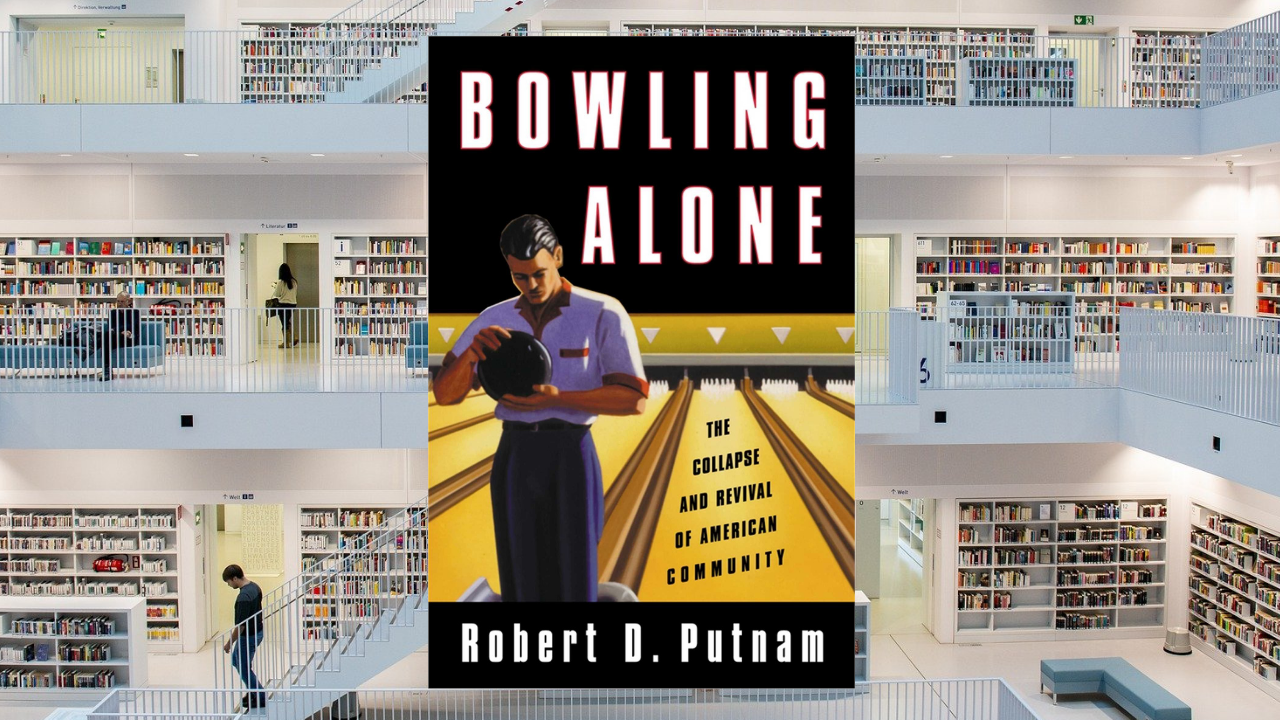
Bowling Alone, by Robert Putnam:
We as a society aren’t gathering with our friends nearly as much as we used to around the middle of the last century, and it’s literally tearing our society apart. This book diagnoses the reasons for that.
It’s about social connection and engagement – and its precipitous decline – in modern America, and although it tells a depressing story, Robert Putnam is still full of hope.
This is a smart, extraordinarily well-researched book, and it belongs on all of our shelves. And then, you know, after reading it we should go out and meet up with some friends!
“A 1998 Department of Justice survey of twelve cities nationwide found that 11 percent of all residents had ever attended a neighborhood watch meeting to help protect themselves from crime (6 percent in the last year), as compared with 14 percent who kept a weapon at home, 15 percent who owned a guard dog, and 41 percent who installed extra locks. In short, we invest more in guns, dogs, and locks than in social capital for crime defense.”
“Education is one of the most powerful predictors of virtually all forms of altruistic behavior.”
“For many of us, the world has been reduced to what we experience on screens. And the things on those screens are not neutral or inert. They’ve been put there on purpose and arranged…to accomplish some goal. Maybe that goal is to make us click, buy or share. Maybe it’s to persuade us, or harden some part of our identity. Most of the time, what these machines want from us appears harmless. Once in a while, it actually is.”
This Book on Amazon: Bowling Alone, by Robert Putnam

The Sane Society, by Erich Fromm:
This was a formative book for me, and it explores the idea that an entire civilization can be sick. It's no measure of sanity to be well-adjusted to a profoundly sick society, says Fromm, and this book is an exceptionally honest, sincere questioning of our collective sanity.
“The whole life of the individual is nothing but the process of giving birth to himself; indeed, we should be fully born when we die - although it is the tragic fate of most individuals to die before they are born.”
“That millions of people share the same forms of mental pathology does not make these people sane.”
“We consume, as we produce, without any concrete relatedness to the objects with which we deal; We live in a world of things, and our only connection with them is that we know how to manipulate or to consume them.”
This Book on Amazon: The Sane Society, by Erich Fromm
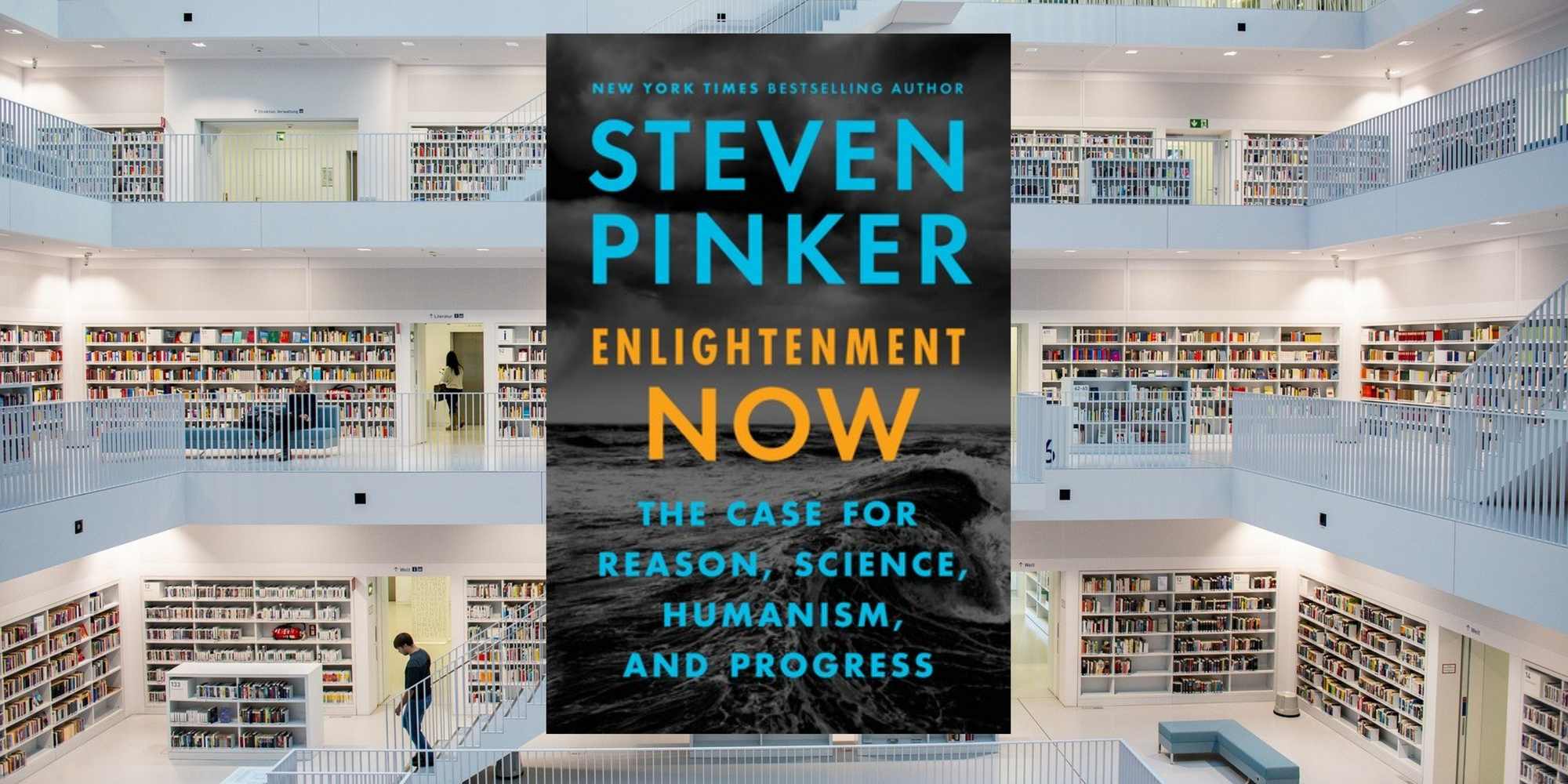
Enlightenment Now, by Steven Pinker:
Since the Age of Enlightenment (also known as the Age of Reason, taking place in the 17th-19th centuries), we have saved billions of lives through scientific advances in agricultural production, health interventions, and improved sanitation; we have ensured the rights and freedoms of billions of people who had before been silenced (still working on that one, of course); we have established global networks of cooperation that are responsible for some of humanity’s greatest achievements, and we’ve laid the groundwork for every possible opportunity, freedom, and success that our future generations will ever experience. We did this with ideas, passion, teamwork, drive, self-discipline, reason, energy, and everything else that makes humanity great.
Steven Pinker does an excellent job here in this book chronicling human progress, identifying where we can do and be better, and examining some of the beliefs and attitudes that are still holding us back. This book is a crushing corrective to those cowardly pessimists who say that humanity is doomed. Humanity is just getting started, and this book will show you why.
“If you’re reading this, you are not dead, starving, destitute, moribund, terrified, enslaved, or illiterate, which means that you're in no position to turn your nose up at these values - or to deny that other people should share your good fortune."
"If news outlets truly reported the changing state of the world, they could have run the headline 'Number of People in Extreme Poverty Fell by 137,000 Since Yesterday' every day for the last 25 years. We live in a world not just with a smaller proportion of extremely poor people but with a smaller number of them, and with 6.6 billion people who are not extremely poor."
"The point of calling attention to progress is not self-congratulation but identifying the causes so we can do more of what works."
Read the Full Breakdown: Enlightenment Now, by Steven Pinker
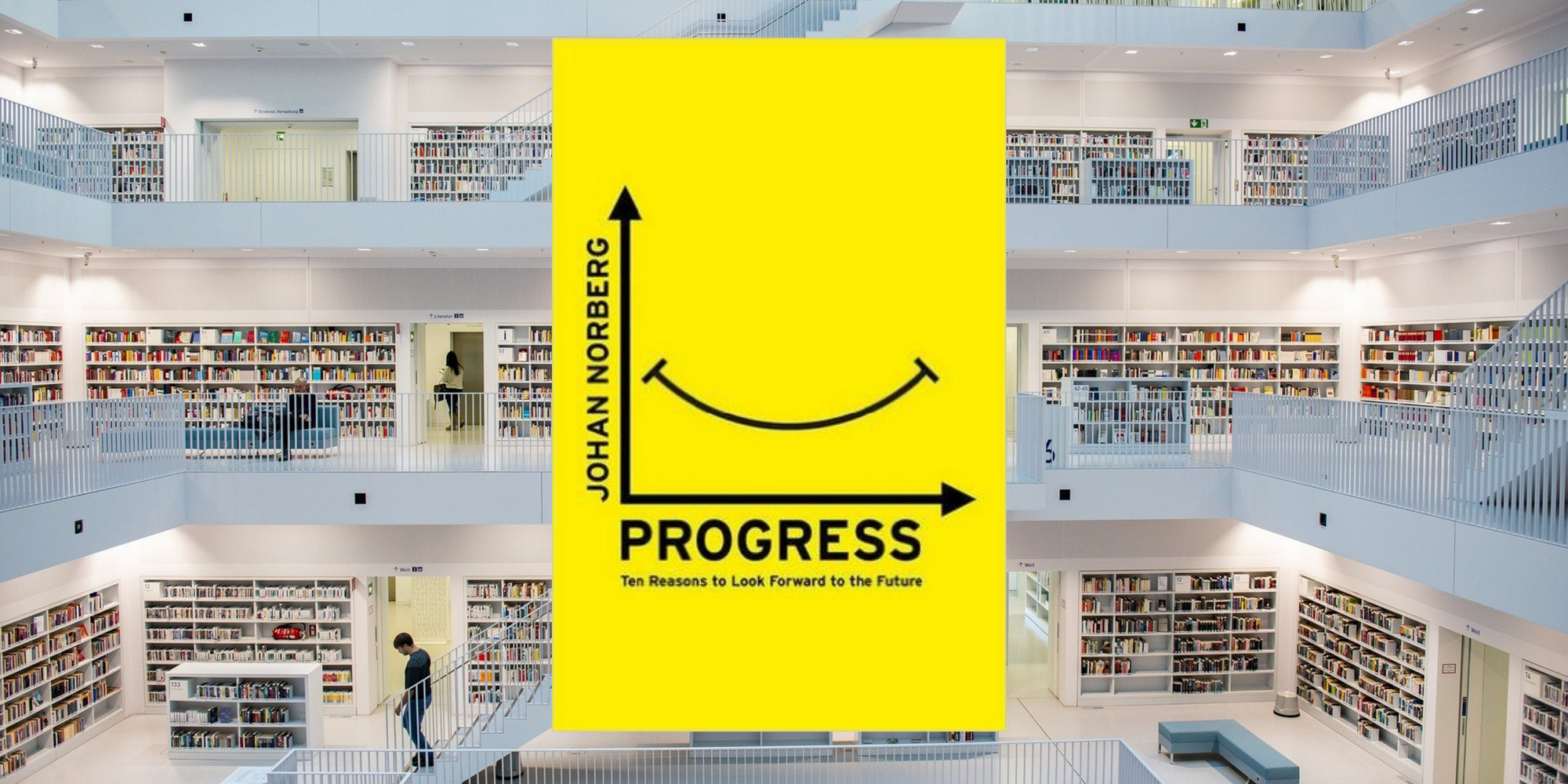
Progress, by Johan Norberg:
Progress is a catalog of all the spectacular improvements in living standards and well-being that humanity has achieved for itself, particularly after the year 1800. Norberg runs down the list - food, sanitation, poverty, violence, equality, etc. - and explains how 2.6 billion people have received access to an improved water source since 1990, how the poorest countries in the world in the 1950s were richer than the richest countries in the world were in 1800, and so much more.
It's evident from Norberg's work that humanity solves more problems than it creates - when it's given the freedom to do so. Humanity is just...awesome. We're gonna make it; we're going to persevere, and we're going to keep making gains, but we need to push hard enough - and smart enough - so that everyone has access to the incredible prosperity for which we've collectively worked and suffered.
“Since 1990, 2.6 billion people have gained access to an improved water source, which means that 285,000 more people got safe water every day for twenty-five years. Depending on how fast you read, another 300 to 900 people will have got access to safe water for the first time before you have reached the end of this chapter."
“In this era of globalization, the most important factor behind a country's success is the success of other countries."
“Humanity has reached escape velocity.”
Read the Full Breakdown: Progress, by Johan Norberg

The View from the Opposition:
No one's ideas are beyond questioning. In this section, I argue the case for the opposition and raise some points that you might wish to evaluate for yourself while reading this book.
#1: Landlords are not the enemy.
The landlords don't come out looking good in this one. Evicted is replete with stories of economic exploitation and callousness on the part of government and many landlords, but of course this isn't the whole story. And Matthew Desmond never claims that landlords are "evil," or "predatory," or anything like that by nature.
So it's not a fair criticism to say that Desmond is being unfair to "good, decent landlords" all across America, but if I were one of them, I could certainly read this book and feel as though my side of the story wasn't really being heard.
Many landlords are trying to support their own families through their legitimate businesses renting out property to needy families, and they have drug addicts and emotionally-volatile renters and more causing destruction of property, trying to pay $50 towards rent and the other $650 "later," and all the rest of it.
As always, it's impossible to make sweeping generalizations about an entire class of people, landlords or renters or whomever else. It's the capacity for nuanced, dispassionate, reflective thinking that will help you to understand poverty in America and the individuals affected by it.
"The test of a first-rate intelligence is the ability to hold two opposed ideas in the mind at the same time and still retain the ability to function.”
-F. Scott Fitzgerald

Action Steps:
So you've finished reading the book. What do you do now?
#1: Look for the helpers.
Mister Rogers' mother used to say that, wherever and whenever a tragedy strikes, you will always find people there who are helping. Her advice to Fred - and which he passed along to all of us - was to look for the helpers. You can join them too.
At JustShelter.org, you can locate hundreds of organizations working hard to preserve affordable housing, prevent eviction, and reduce family homelessness. Use their map to search over 600 organizations all across America and find out how to make a difference in your community.
At the national level, JustShelter.org lists 14 organizations working to affect policy change, and you can assist their efforts as well. Or, if you live somewhere else and want to fund lifesaving work all over the world, you can donate to Doctors Without Borders, one of the world's leading humanitarian relief organizations, and the recipient of the Nobel Peace Prize in 1996. There are helpers all over the world, and you can join them today.
About the Author:

Matthew Desmond is a professor of sociology at Princeton University. After receiving his Ph.D. in 2010 from the University of Wisconsin at Madison, he joined the Harvard Society of Fellows as a Junior Fellow.
He is the author of four books, including Evicted: Poverty and Profit in the American City (2016), which won the Pulitzer Prize, National Book Critics Circle Award, Carnegie Medal, and PEN / John Kenneth Galbraith Award for Nonfiction.
The principal investigator of The Eviction Lab, Desmond’s research focuses on poverty in America, city life, housing insecurity, public policy, racial inequality, and ethnography. He is the recipient of a MacArthur “Genius” Fellowship, the American Bar Association’s Silver Gavel Award, and the William Julius Wilson Early Career Award.
A contributing writer for the New York Times Magazine, Desmond was listed in 2016 among the Politico 50, as one of “fifty people across the country who are most influencing the national political debate.”
Additional Resources:
Media and Interviews for Evicted
This Book on Amazon:
If You Liked This Book:
The End of Poverty, by Jeffrey D. Sachs
Man's Search for Meaning, by Viktor Frankl
Bowling Alone, by Robert Putnam
Nickled and Dimed, by Barbara Ehrenreich
Can't Hurt Me, by David Goggins
The Good Neighbor: The Life and Work of Fred Rogers, by Maxwell King